I can tell you exactly where I was when I found out Prince died. Alzo sent me a one word text. The shock had me hitting the internet to double check. I miss Prince. I’m no super fan but it’s hard to believe he’s dead. He was a force of music and attitude that’s gone but still present as well. I take solace in my appreciation for Prince’s favorite color purple. Looking for examples around his birthday is my offering of tribute.
At some point I found myself at a practice space building on Burnside, a very Portland kind of establishment, with the name that involved the word Gnome (Metrognome.) Waiting to get in, I was struck by the purple border surrounding the building.
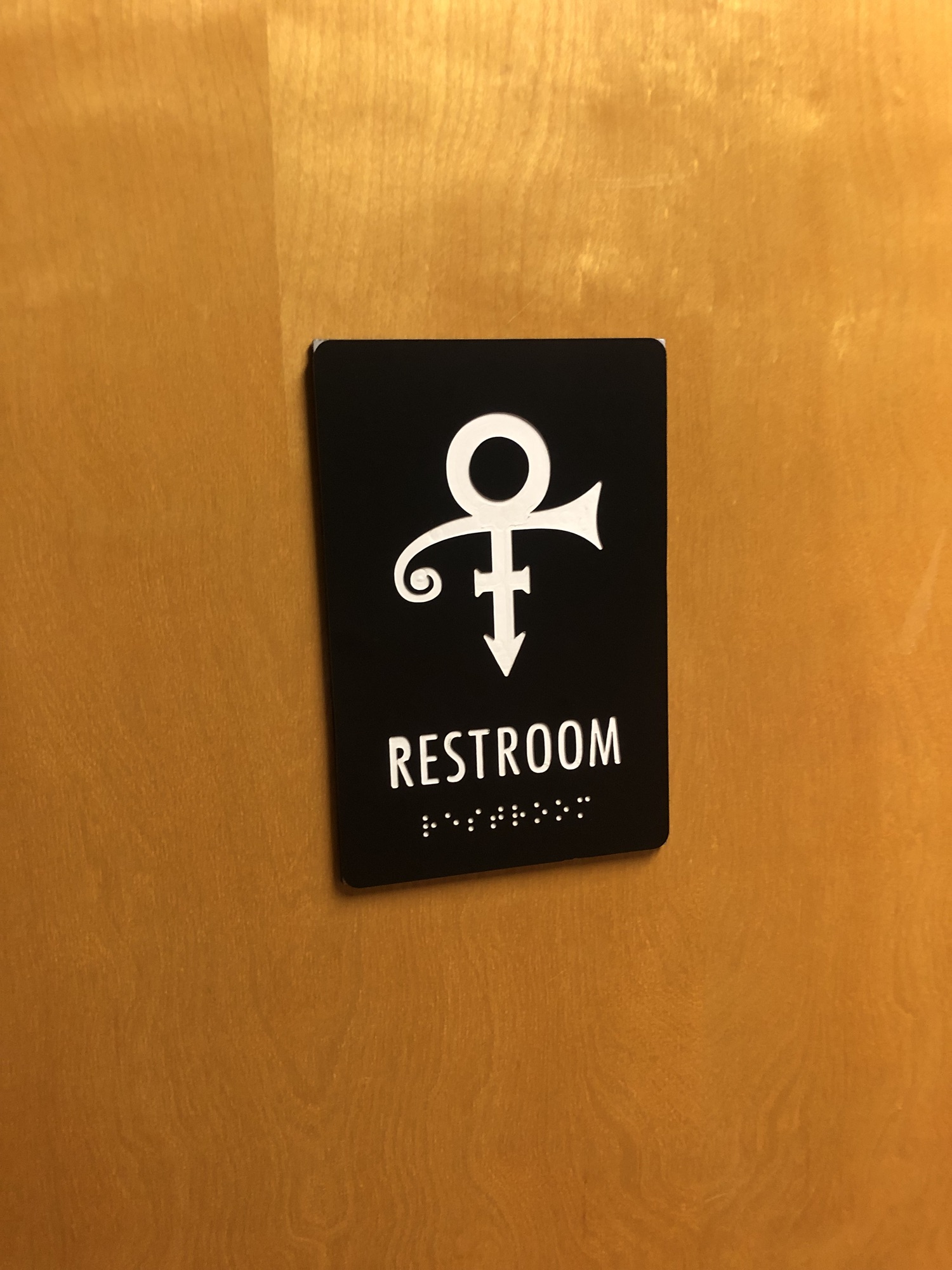
Inside, I discovered a purple bathroom beyond the door sporting Prince’s symbol. Was I seeing Prince’s favorite shade of purple? Who cares, and close enough; purple is purple, right? It’s nice to find a Prince tribute anywhere. Inside the practice space not a note of funk could be heard beyond the space dub that was blasting but eavesdropping on a Prince tribute band rehearsal would have been asking too much.
Purple bathroom.
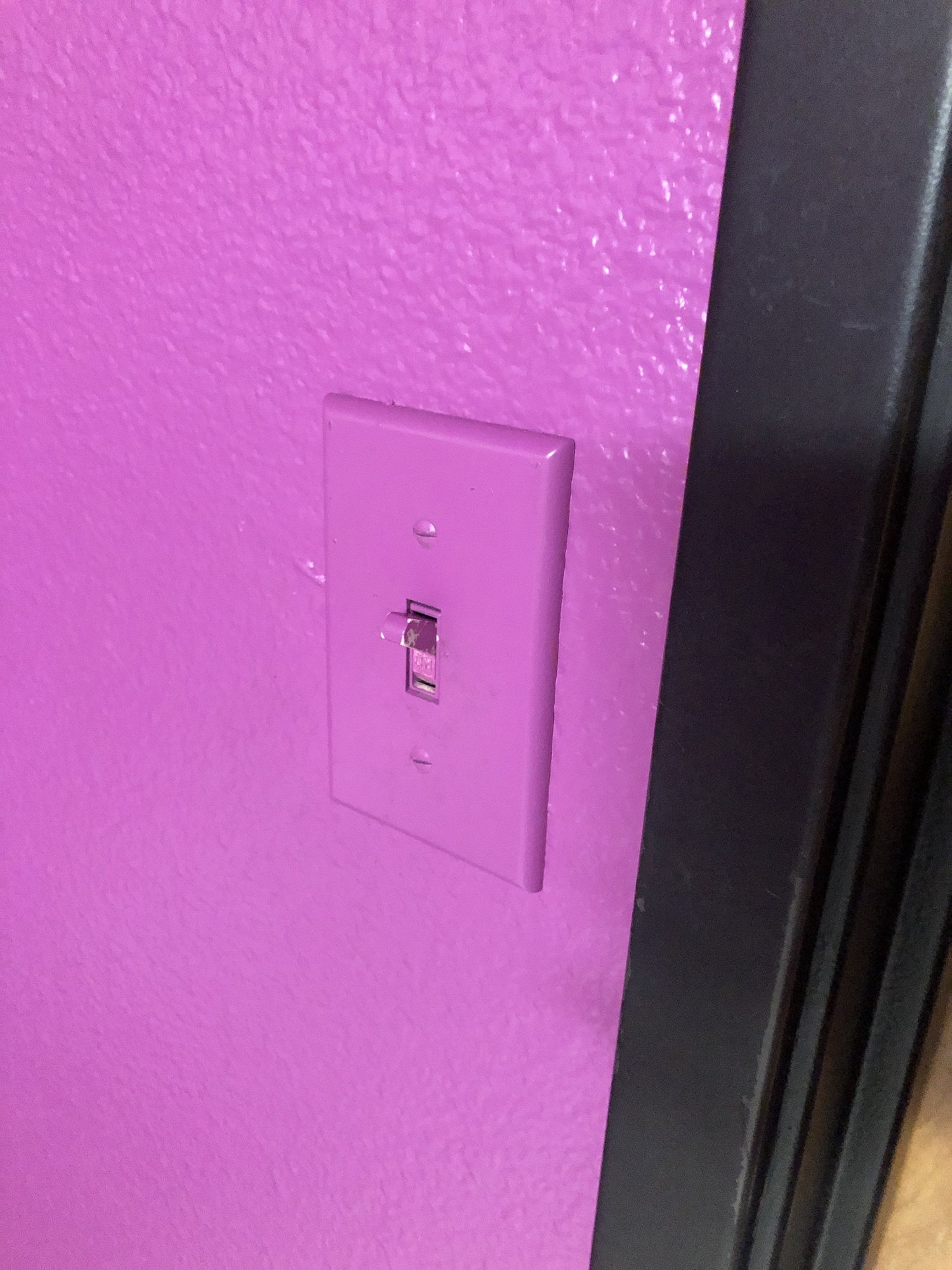
Purple light switch and light plate.
Purple border.
Portland was filled with legends about Prince performances, a blistering set at an after hours after party–whatever you call those things and there was a late career appearance that featured an all-lady back up band. Somewhere in my archive is a double cassette of the first two albums, the funky, punky stuff, Ronnie Talk to Russia and When You Were Mine, but I like to think of Prince travelling, or floating through town in a semiconscious dream state gazing out of a limo window and enjoying any shade of purple he may have seen. **And, of course, Portland has experienced its share of purple rain, whatever that might be.
Purple bathwater.
Purple mailbox.
Purple abstract art.
Purple bench, Oaks Amusement Park.
Purple parking garage column, Hillsboro.
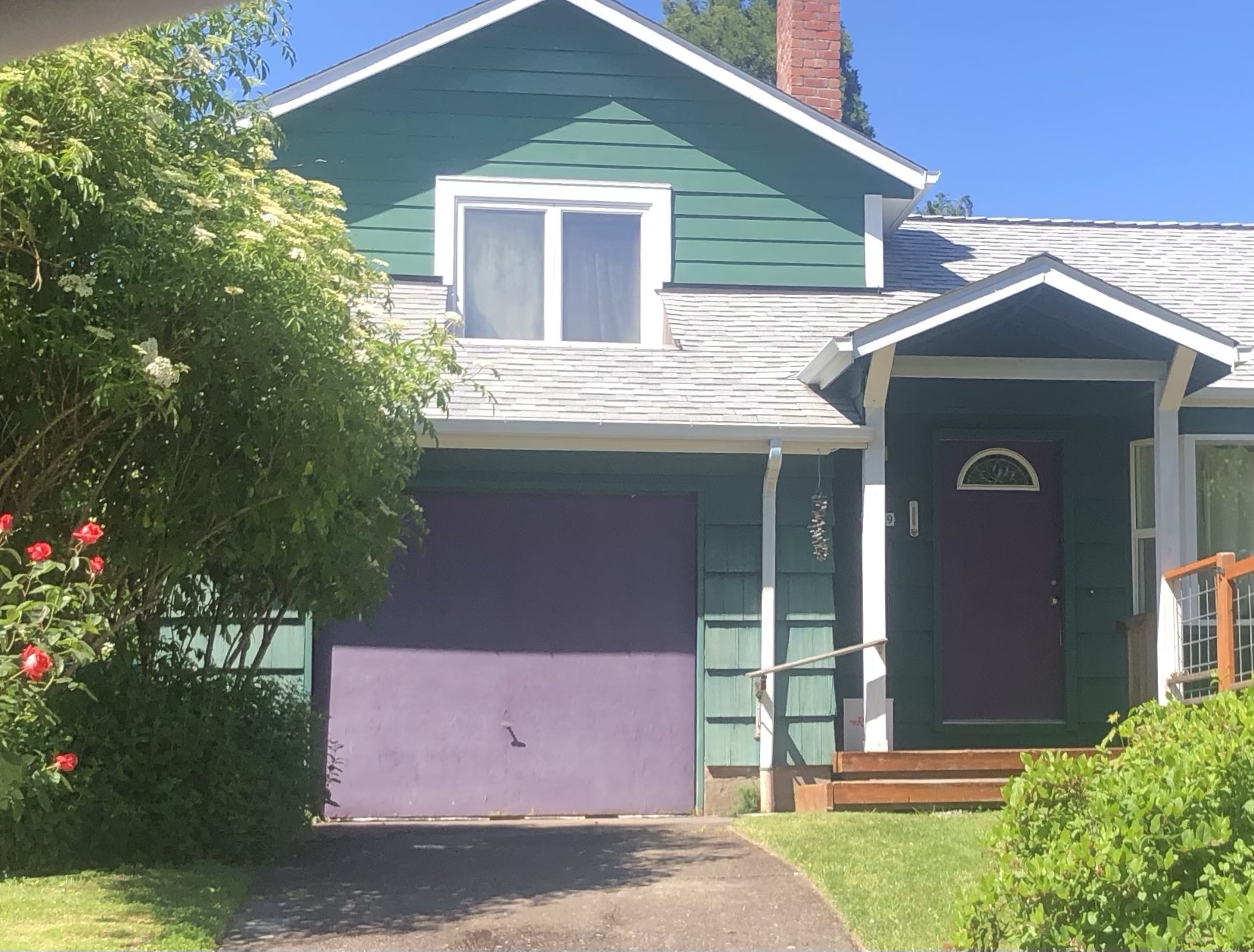
Purple garage and door, Maplewood neighborhood.
Purple chipped nail polish.
Purple drink.
**I have to say Mrs. Yuchmow that I debated long and hard about starting this sentence with the word “And,” but in the end it felt good making it feel right too.
Hallowed ground. The former Northwestern Recorders, Burnside and 13th Ave, where “Louie Louie” was recorded.
Editor’s Note: Guest columnist this week is Will Simmons from the Pittsburgh Orbit. His love of the the Kingsmen’s version of “Louie, Louie” has inspired a slew of forthcoming posts to celebrate the 54th anniversary of the recording. He’s won me over as I realize Will isn’t spewing hyperbole.
It is the greatest moment in rock-and-roll. I can say that definitively–I know them all.
Oh, sure–there’s Jackie Brenston and pre-spousal abuse Ike Turner’s “Rocket 88”, the so-called “first rock-and-roll song”. Elvis, whose famous croon and gyrating mid-section is right up there with the crazed abandon of Little Richard and Jerry Lee Lewis. Chuck Berry is a one-man honors course on the past, present, and future of the genre.
The Beatles launched a million shrill screams and sent inspired amateurs from all over into guitar shops. Their across-the-pond mates The Kinks, The Who, and the Rolling Stones all launched impressive salvos at this hallowed target.
Somebody’s going to argue for Robert Johnson selling his soul down on Highway 61, Sister Rosetta Tharpe’s rock-and-roll gospel, Dylan “going electric”, Janis Joplin’s impassioned ball-and-chain wails, Hendrix on his knees and out of his mind at Monterrey. “Rock and Roll, parts 1 & 2”, Mike Leander’s Frankenstein studio creation for Gary Glitter, was famously called “a castration op where you throw away the patient and keep the balls”. Queen’s “Bohemian Rhapsody” set some kind of high-water mark, but it’s not this one.
We could go on and on–heck, we haven’t even gotten to punk rock!–but what’s the point? No, “Louie Louie”–The Kingsmen’s definitive “Louie Louie”–recorded on this day in 1963, alone holds that title. And it happened right here….er, right there…in Portland.
Tim Bavington’s glass and acrylic sculpture “Louie, Louie” (detail), Edith Green-Wendell Wyatt Federal Building downtown
Kids today. One thing they’ll never know is the absolute moment of greatest excitement in life. I’m talking about the brief seconds immediately following the record player’s discordant crunch–like a car crash heard from blocks away–as the needle makes contact with spinning black plastic. From that instant until the music kicks in–possibly nanoseconds, a blink of an eye, really–there is nothing except the amplified scratching of dust on empty grooves and a heightened anticipation that something incredible is about to happen.
When the needle drops on “Louie Louie” it has every molecule of this electricity behind it. The organ pick-up on the V chord and one run-through of the progression is just enough warning for rockers to rise from their seats and the timid to dive for cover.
Lynn Easton is a sonic terrorist wanted for crimes ranging from flagrant tempo irregularity to rampant contraption kit abuse. But then as now, there are no normal circumstances and Easton’s all-fills-all-the-time, no-crash-cymbal-left-alive approach to drumming is exactly what you want destroying rhythm in the scorched earth ground war that is rock-and-roll.
What takes “Louie” over the top, though, are the loose, drunk-sounding, shout-sung vocals of young Jack Ely. It’s just one of the song’s many magical quirks that the record was done in a single take, recorded live in the studio using just three room microphones, by a band that only just added the song to their repertoire. When Ely sings through his teenage orthodontal work, craning to be heard over the live band din, he’s working from only a passing familiarity with both the new lyrics and arrangement.
It all adds up to one of the great vocal performances in rock history. No one would possibly practice singing a song the way Ely delivers it. Likely–had the band been granted more studio time, budget, a producer–they might have rethought the spontaneity of this first, perfect take. Fortunately for all of us, they never got that chance.
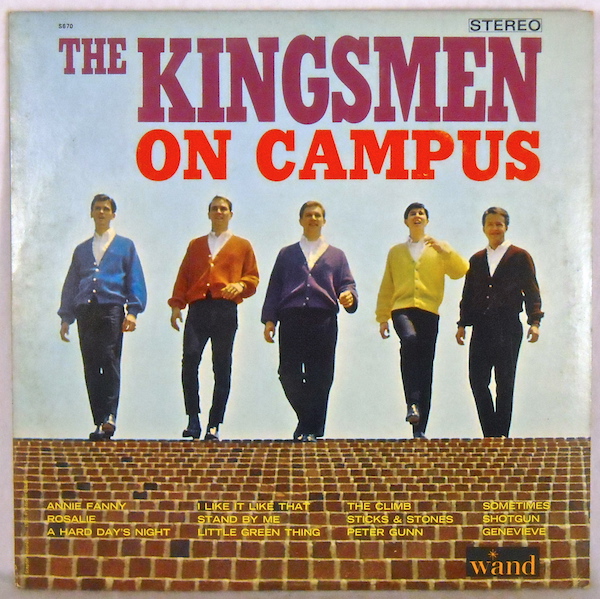
If the cardigan’s a-rockin’… big Kingsmen on campus (1965)
By all accounts, Ely, Easton, and the gang were pretty square. From the band’s Wikipedia entry, “The Kingsmen began their collective career playing at fashion shows, Red Cross events, and supermarket promotions, generally avoiding rock songs on their setlist.” The group only fell into trash rock ass backwards after hearing the popularity of an already-recorded version of “Louie Louie” while playing at the very un-rock-and-roll venue of a yacht club on the coast.
There are plenty of wilder early rock records that pre-date “Louie’s” moment of glorious infamy, but none that got anywhere near the exposure The Kingsmen received. Coming at the tail end of the brief window between Elvis leaving the building and The Beatles “yeah-yeah-yeah”-ing arrival, “Louie” is the great exclamation point that ushers both popular and underground rock music into the 1960s. When the record peaked at #2, in December, 1963, the Billboard’s Top 40 chart contained such ’50s hangovers as Neil Sedaka, Bobby Vinton, and Al Martino, “Be True to Your School” and “Wives and Lovers”*. The top spot was held by The Singing Nun’s folky “Dominique”, sung en Française.
An old-school phone listing is all that’s left of Seaside, Oregon’s Pypo Club, where The Kingsmen first heard “Louie Louie”.
The Kingsmen went on to record a series of albums in the mid-1960s full of decent, but forgettable R&B standards, dance-craze-of-the-week retreads, and unfortunate novelty tunes. It didn’t help matters that shortly after “Louie’s” success, Easton staged a bloodless coup to unseat Ely as lead singer and frontman. In one fell swoop, the band lost both of their greatest assets–the untrained voice and the unhinged beat.
Jack Ely’s post-sacking, hack lineup of The Kingsmen, c. 1964 [photo courtesy of the Oregon Historical Society]
None of these things mattered to me. As a high school student in the 1980s, I bought used-bin copies of all their records and played them incessantly. My peers were listening to Siouxsie & The Banshees and The Cure while I was spinning The Kingsmen’s B-grade takes on Allen Toussaint and Rufus Thomas songs.
Looking back, I recognize how mediocre the Kingsmen’s second- or third-hand, safe-for-middle-America versions are in comparison to the real thing. But those albums served as a great gateway to finding out about much more interesting music–both in the New Orleans/Memphis R&B records they copied and the mid-’60s garage rock they became synonymous with.
The Kingsmen will never be remembered for the catalog produced by ‘60s rock peers The Pretty Things or The Troggs, The Chocolate Watch Band or The Sonics, The Standells or The Easy Beats. But they did one magical, perfect thing–right there at Burnside and 13th. It changed this blogger’s young life and he is forever in their debt. Me gotta go. Aye-yi-yi-yi-yi.
Hyperbolically yours,
Will Simmons
Pittsburgh
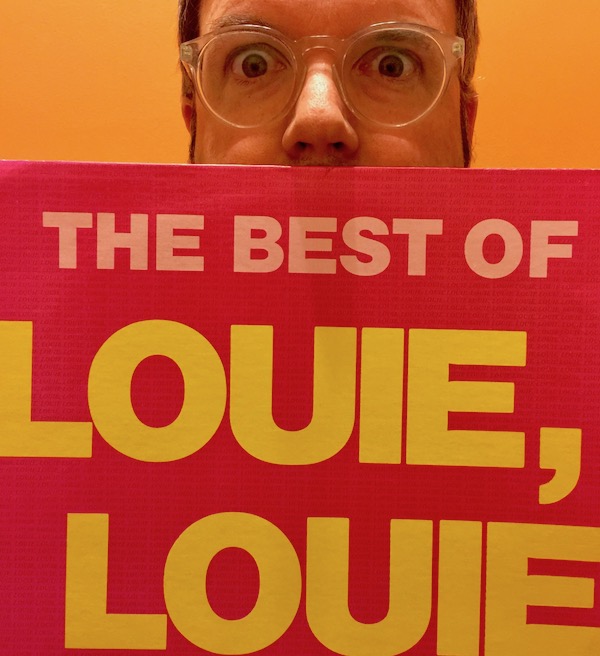
The author, one needle-drop from ecstasy
Further reading: Dave Marsh’s 1993 book Louie Louie: The History and Mythology of the World’s Most Famous Rock’n’Roll Song (Hyperion) is a totally great read for anyone with even a passing interest in the song, Northwest rock history, or just a goofy, wild true tale. It’s amazing to me that Multnomah County Library only has one (print) copy in the system considering how much of the book could be considered “local history”, but hey–it’s available! (as of this writing)
* In fairness, the Dec. 14 Billboard Top 40 also contains some pretty good stuff–“Walking the Dog”, early Motown records, “Sugar Shack”, etc.
Next week in the second installment of the Louie Files, we’ll explore an attempt to find the rock club in Seaside, OR that inspired the Kingsmen to record Louie, Louie.









 Portland Orbit