Free Air and Phone: Perks of the Motel Sign

For anyone passing through Portland, it must be nearly impossible to decide where to stay. If you want the motel experience, not only do you have to determine whether the name on the sign, as well as the sign itself suits your taste, you have to consider additional information that may be provided. How many TV channels are you going to get? What if you want a jacuzzi in the room? You always assume you’ll have wi-fi access but do you know? Direct dial phones? Air conditioning? TV? Sometimes it’s the bonus features that make or break the deal. The extras might make the price right. If you’re looking for more than a bed and a pillow you have to consider the features you can or maybe can’t live without for a night or two. Some motels list room features directly on the sign while others have added a marquee for that purpose.

SW Barbur Blvd

Lately, I’ve spent time driving up Interstate and walking and driving in SW where I began to look past the coolness factor of the  signs and discover aspects of them that began to appear absurd.  There were outdated listings of luxuries we now take for granted like phone service, TV and air conditioning. I appreciate the older signs. They look even better in the evening when their neon lights cut through the dark. It’s likely people don’t really consider the quality of the motel signs or mull over specific offerings when choosing a place to stay but for the purpose of writing about motel signs I decided I needed a gimmick.

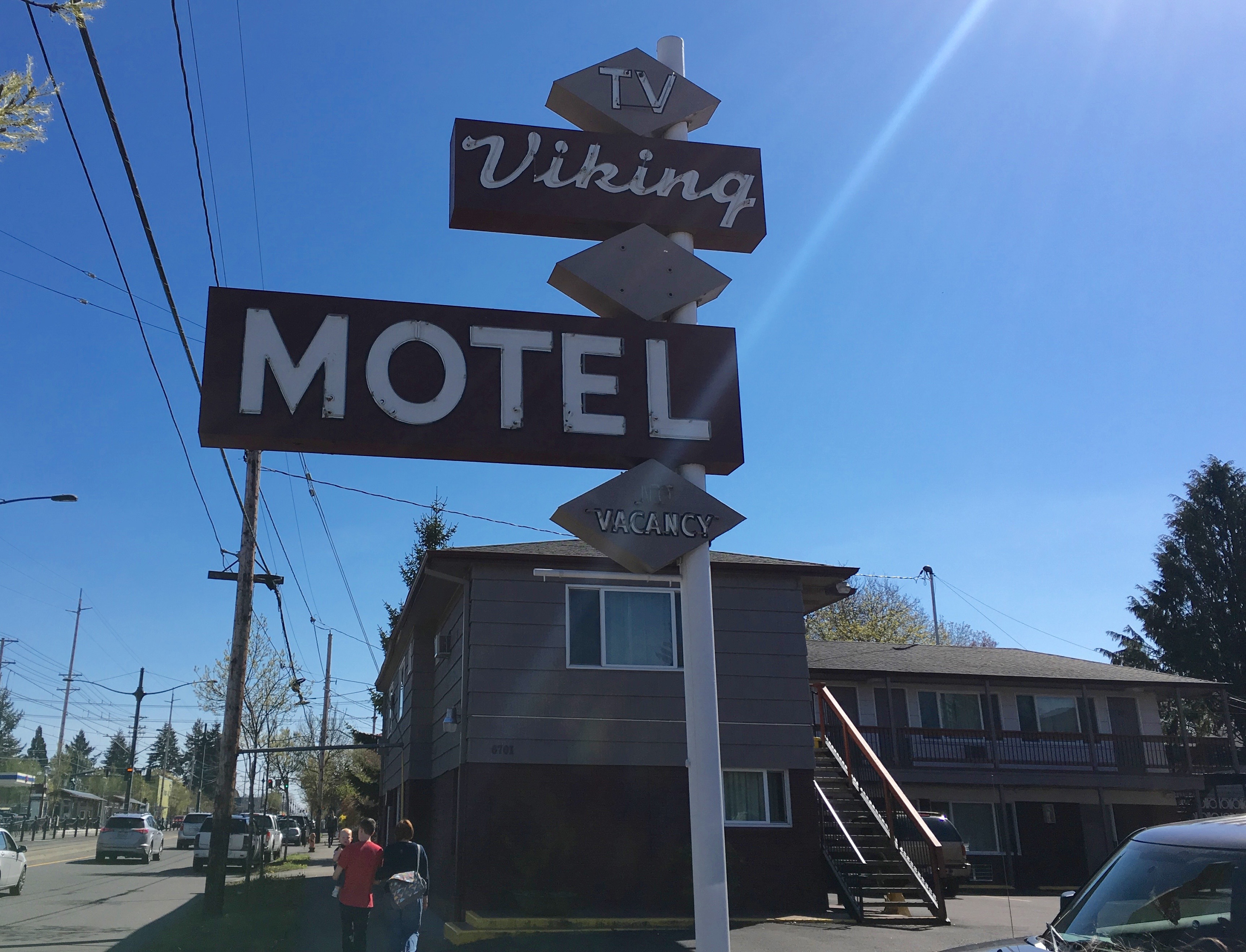
N Interstate Ave

Fans of the Vikings television show probably won’t find any real Vikings staying at this motel. TV is listed at the top of the sign so it’s a given you’ll have something to watch and hopefully you won’t miss an episode. Otherwise this motel is keeping its offerings on the down low.

N Interstate Ave

This is one of my favorite motel signs in town. I’m not sure why. It could be the cowboy hat. It’s obvious the sign is old. It seems like direct dial phones were possibly a key selling point a long time ago. At least the TV you watch will be in color and the room temperature should be cool.

SW Barbur Blvd

Another old sign that has seen some wear and tear. If you’re looking for phones and kitchens you’ll find them at the Ranch Inn but free cable TV with 32 channels and Showtime movies is the real bargain.

N Interstate Ave

This is another of Portland’s finest neon signs. At night the monkey is more animated moving up and down the  tree. The addition of a marquee allows for increased sales tactics. Free TV seems to have been as much a part of the original sign as the neon monkey.

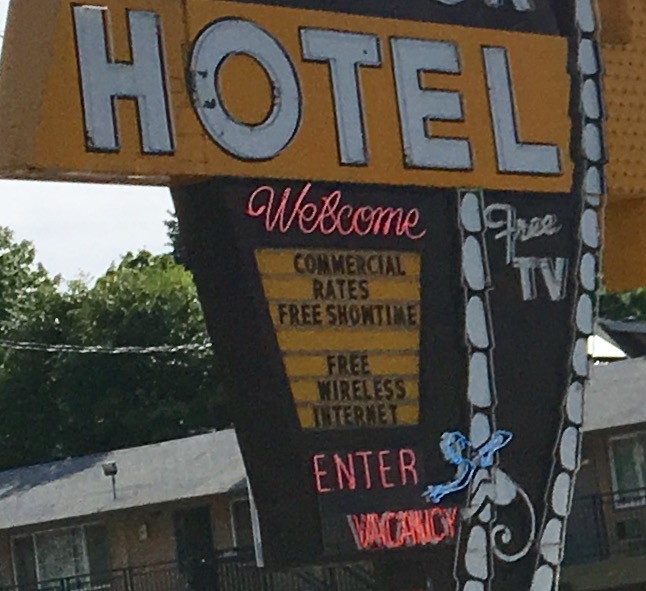
Palms sign, detail

Showtime shows up again along with commercial rates and internet. Free stuff shouldn’t make the room cost anymore.

N Interstate Ave

When the S in the sign is shaped like a dollar sign that has to imply you’ll be getting a good price. Throw in free high speed internet and you’ve got yourself a deal.  You’re not staying at a motel either. It’s an Inn.

NE MLK Blvd

How are you going to settle for anything less than an in room jacuzzi at any price? I loved the old sign before it was replaced. I’m sad to say I never took a photo. The new design did not include additional room perks but if you have an in room jacuzzi what else would you need?

N Interstate Ave

The Monticello makes excellent use of the marquee below the picture of Thomas Jefferson’s old home with an arrow going through it. All your questions should be answered. The motel has some tempting incentives, DSL and HBO too, although in my personal experience I can only think of one hotel experience where HBO actually had something on their schedule that I wanted to watch.

SW Capitol Hwy

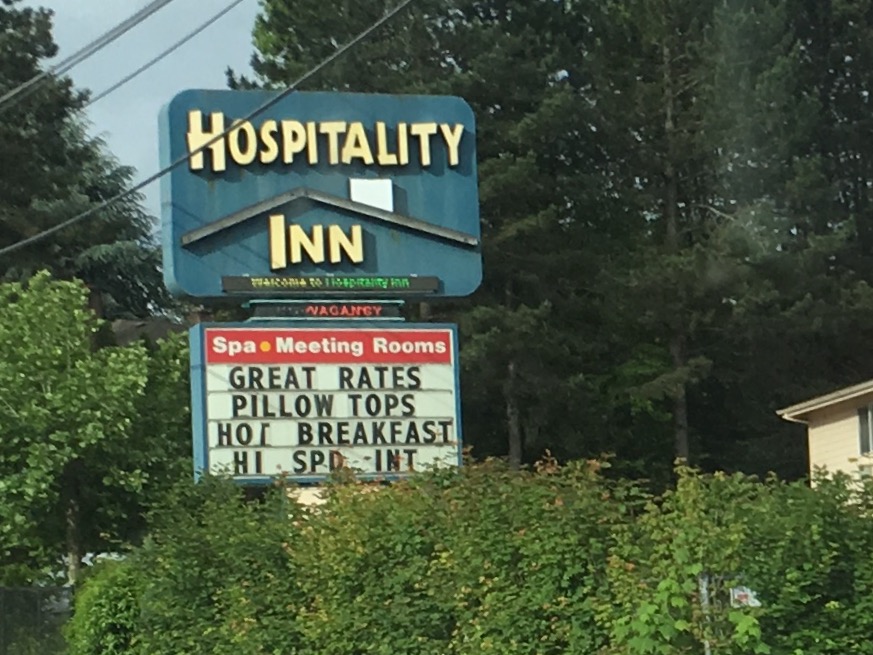
I’m getting excited about this sign. I like the lettering font and the simplistic logo. Below the word Inn is an animated sign board offering a welcoming message. Spa, pillow tops, and hot breakfast feels like a little bit of heaven and certainly hospitable.

N Interstate Ave

This sign does not make good use of it’s letter board, but it does have the phrase “Affordable Rates” at the top. This is a rallying cry to cheapskates like me. Has this Inn economized on room perks? Can I at least get some ice in my bucket? There is only one way to find out.

Budget Motel Back view

N Interstate

This sign seems to be in the process of refurbishment. The lettering on the marquee is one of the only instances I’ve seen of a motel offering a special deal which makes for an extra special use of their lettering board.

Budget Motel

A better view.

Here’s a better look at the Budget Motel sign before the special offer had  been placed on the marquee.

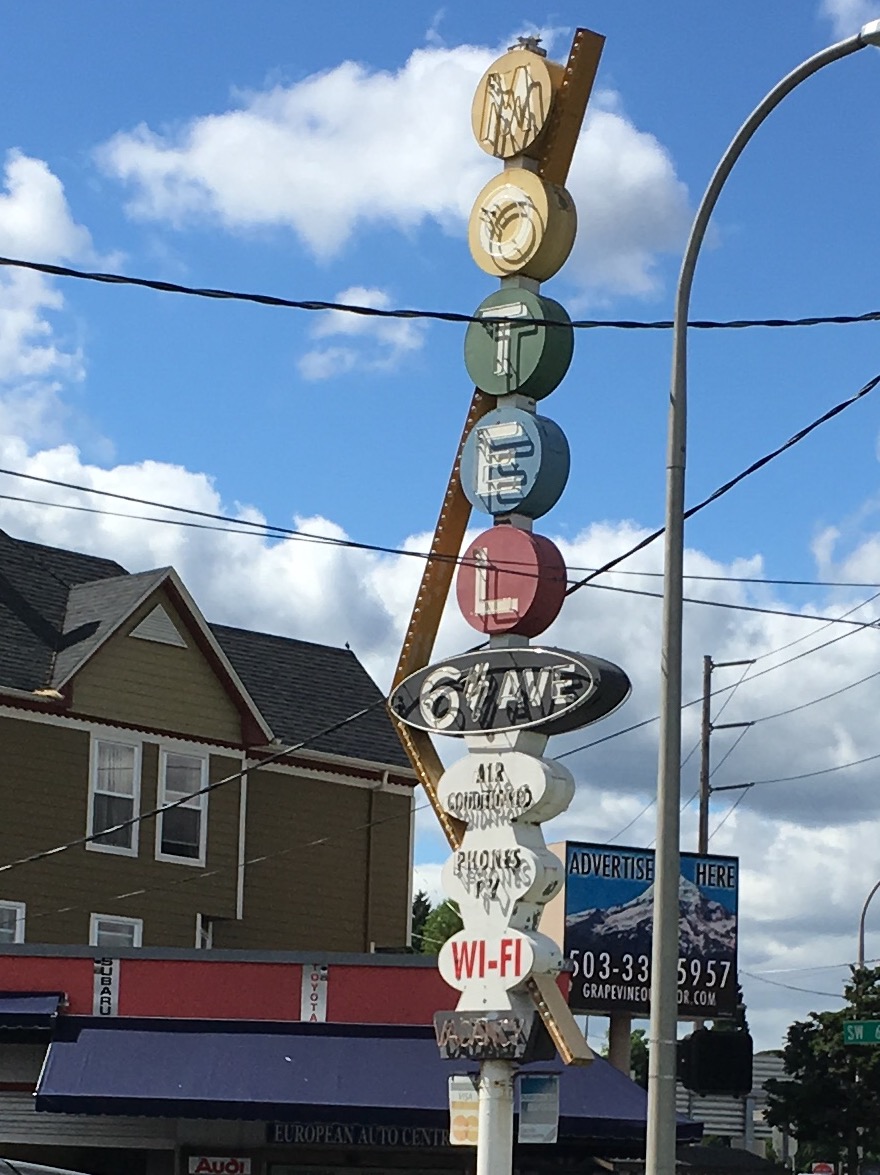
SW 6th Ave

This is a beaut of a sign that snuck up on me on one of those traffic-is-always-bad-on-Thursday afternoons when I took a detour to get home. Back in the day AC, phones and TV seems to be what everyone was looking for. The WI-FI looks like a late addition. I’m going to go out on a limb and praise this as an incredible example of mid-century modern design. I may even be wrong about that, but what do I care.

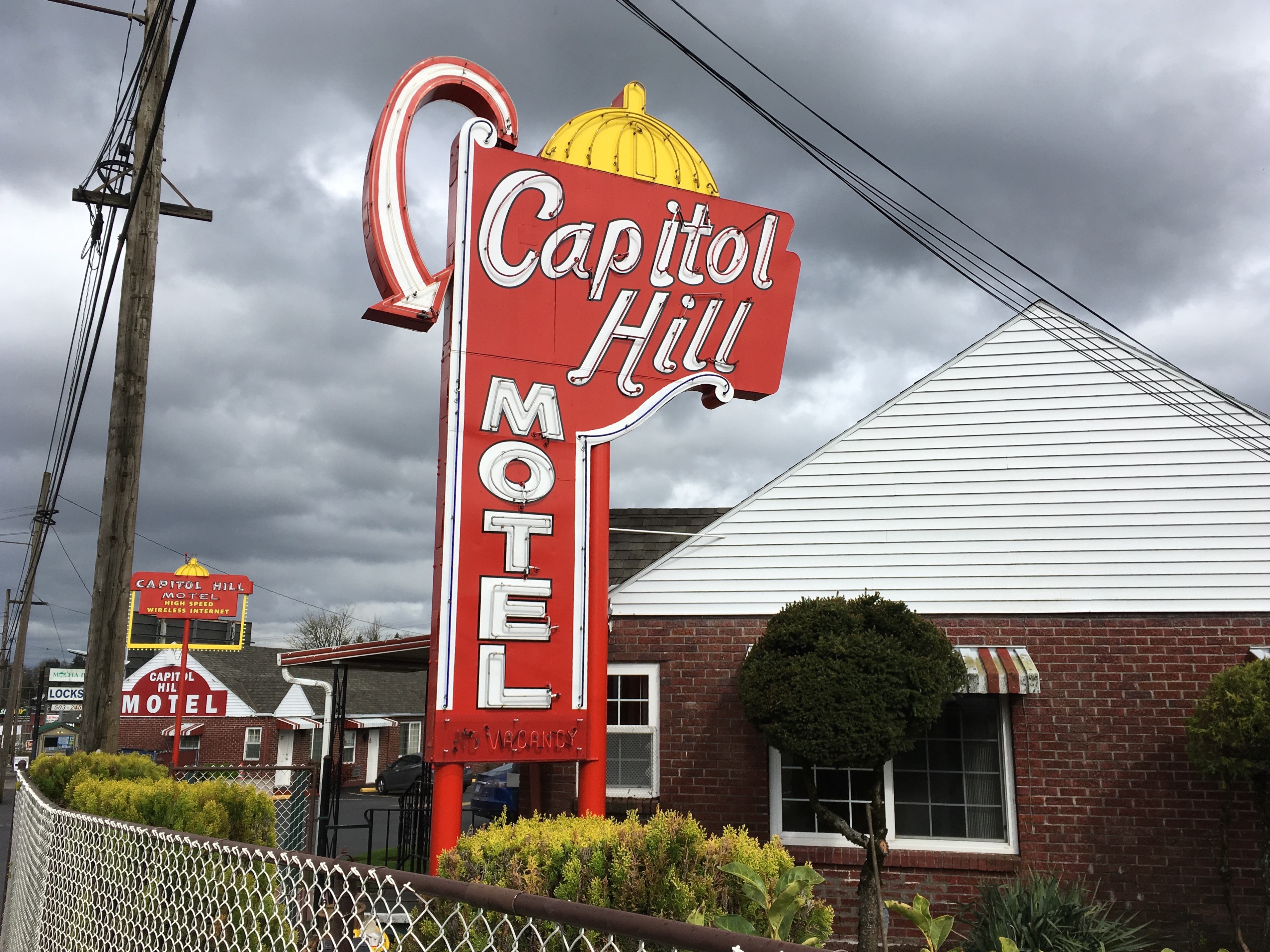
SW Barbur Blvd

The sign alone makes me want to spend time at this motel. I’d gladly walk up and down the sidewalk out front admiring the sign’s dome and swirling arrow anxiously waiting night fall when the sign would be illuminated. In the background a smaller sign advertises high speed wireless internet. There is no need to offer much else when the main sign looks this good.

SW Barbur Blvd

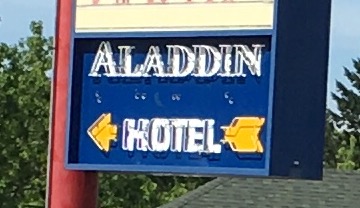
Kitchenettes and suites are the main draw for the Aladdin Motel. It’s not often that I think of baking anything when I stay in a motel. The sign does have the bonus feature of being part of the Barbur Plaza sign plan. These aren’t exactly in-room perks but you do have the option of getting your nails done, grabbing a gyro, pizza, a gun or some vaping gear while enjoying your stay at the Aladdin.

Editor’s Note: Many of the photos in this piece were taken while driving. This is not something the Portland Orbit advocates or recommends. It is now being insisted upon that all photographers stop and exit their vehicles before taking pictures.

Next Week: The Purple Post

Creepy Stairs, Not Stares

In the beginning.

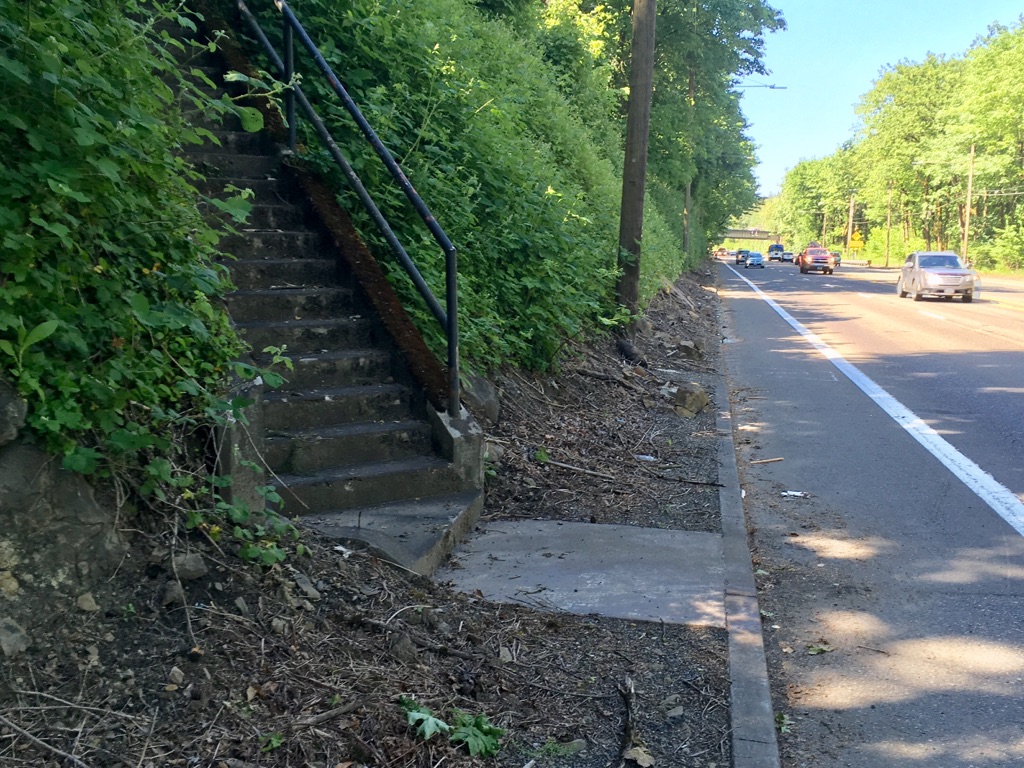
On a sunny afternoon the opening to a long winding staircase peeks out onto SW Barbur Blvd. The stairs begin dark and gloomy. Surrounding trees and brush block out the sun. The steps appear in an uninviting section of this busy four lane road offering an escape from a dirt and gravel shoulder. I had no idea where they led but anywhere, even a route that required taking sinister steps had to be better than the starting location. It has the feel of a live action Candy Land game. If you land on the space you ascend the stairs.

Paint job needed.

I have read a few blogs posts in the Pittsburgh Orbit about that city’s stairs. The weekend before I checked out these mystery stairs, a friend had mentioned The Portland Stairs book. I know Portland has a network of stairs too but I’m not familiar with them. Pittsburgh stairs were constructed for workers to be able to get down the hills to the factories below. With Portland it’s a given that if you live on a hill you would also need steps.

It’s not the tree that’s crooked.

The more I drove past these stairs the more curious I was about where they led. They seemed strange to me. I wondered where someone would go if they took the stairs down the hill to Barbur Blvd. The closest location of significance is the Fulton Park and Community Center or the Portland French school up the road. The stairs have a middle of nowhere feel. It makes more sense to use the stairs to get away from that section of road. I spent the first five months of the school year commuting by bus and train but since I’ve become a regular driver I’ve forgotten what it’s like to be a public transportation user or a pedestrian. The stairs provide an easier way to get up the hill. The other option would huffing it up and around a steep street. There has to be a few people who benefit from the stairs’ location.

The 201st step.

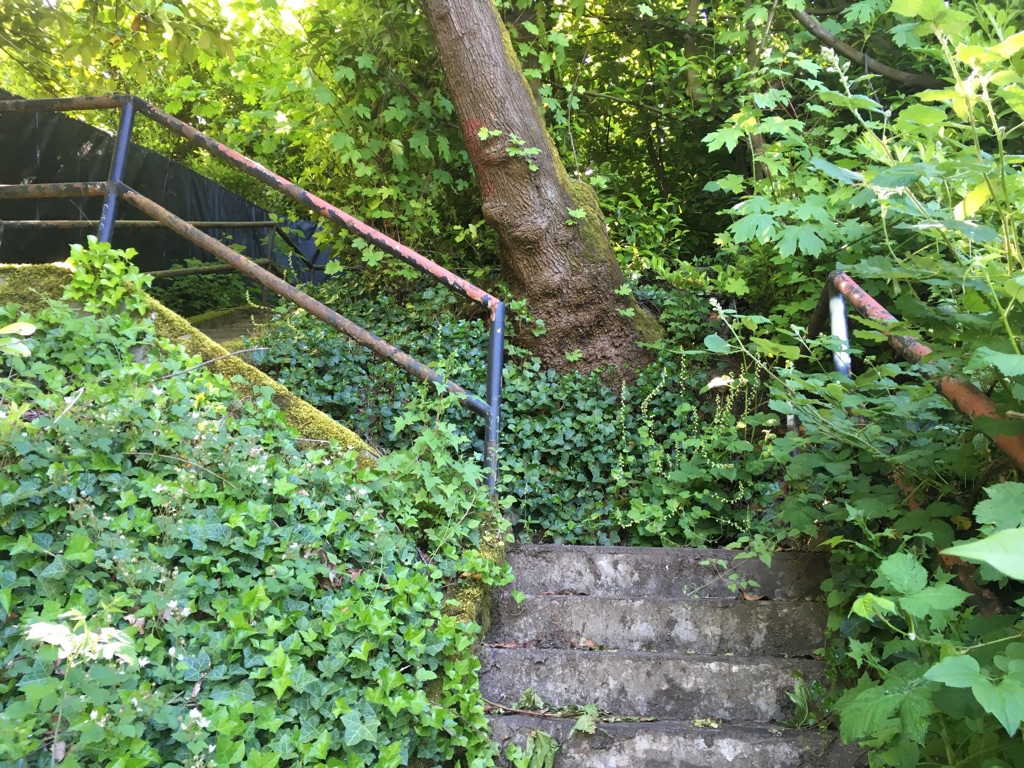
I headed up the stairs after parking the car on a steep incline on SW Parkhill Dr and walking over. There was never a more aptly named street. It’s hard to tell how much the stairs get used. Graffiti on one of the stair walls had been painted over but the railings suffered from peeling paint and lichen growth. Closer to the top, a pair of pants had been draped over a railing. The stairs proved to be winding but not unyielding. The steps did a nice of job of cutting through the forest and brush. It wasn’t a bad walk as I strode up the stairs with plenty of landings along the way. I spotted daylight and the landings stopped. I was stepping through tall bushes towards sunlight. I popped up in a sedate neighborhood between two nice homes on another section of SW Parkhill Dr. I was able to look back and see a terrific view across the Willamette River. After I headed down the stairs and got back to the car I lamented not counting the stairs. A stair count would offer a sense of how far up the hill the stairs go. A specific number would be impressive. I chose not to return to the stairs to count but my estimate would be at least 300 steps.

Outdoor pants drying rack?

I know there are plenty of stairs in the West Hills and other parts of Portland. Something tells me that they must be impressive if a 147 page book has been written about the subject. I haven’t had the opportunity to explore them. At this point I’m just trying to keep up with the Pittsburgh Orbit. If they’re writing about stairs, I write about Portland’s version. I found my transplant self emerging reflected by my ignorance of stair history, but it felt good to take a few minutes to check them out instead of continuing to drive past them everyday giving them little thought. On the stairs I didn’t run into trolls, sketchy or pantsless people and I didn’t end up reenacting a Portland version of that scene out of the Exorcist. There are more steps out there with there own stories or at the very least some better views.

Post Script: As I was posting this I discovered on the community walk website that the Barbur Blvd stairs are known as the Nebraska Stairway and have a total of 147 steps. My estimate of 300 steps was way off but a good guess considering I had walked up and then back down the steps. That math has me off by only 6 steps. I checked a copy of the Portland Stairs Book from the library which is the first step in my becoming a stairs expert.

Tire Art Roundup Part 1

It’s a safe bet that nobody from Goodyear, Firestone, Les Schawb or other tire sellers and manufacturers could imagine that one day tires would form the basis of incredible art. There is a glut of tires in the world. They wear out but exist in a useless, worn out form. We pay disposal fees and forget about them. Old tires become the stuff of billowing, smoky tire fires. They are made into sandals and welcome mats. Used tires have multiple uses but that’s what I thought up off the top of my head. So why not art? Their material usefulness and ability to be repurposed is proof of this possibility.

I became conscious of Tire Art last year. As I was riding my bike to work through the St. Johns area each day I would vary my route either to find a quicker way or as a means to break up the monotony. One route delivered me to a dead end. In front of a house sat two tires one of which was painted. The combination of paint and tire is sometimes, but not always, a sign of Tire Art. It made me consider the tires way up on Columbia Blvd., planted in the dirt and painted. I think there were flowers inside. I’m still searching for the best moment to capture the essence of this display with flowers in full bloom and the tires painted and shining in all their sunlit glory. There will be a second post. There’s only so much tire art any one can digest at one time so I’m keeping the portions small.

In the Swing of Things

To offer greater perspective on Tire Art, allow me to present the classic tire swing.

The classic!

It seems timeless and true, harkening back to a bygone era, mind you as you are all probably well aware, it has nothing to do with actual Tire Art.

But when a tire is chopped up and restyled, this reimagination is a transformative art form.

Neigh.

At this point the tire serves double duty but mostly remains Tire Art until it finds itself in use as a tire swing .


Make a Wish

Wishing you well.

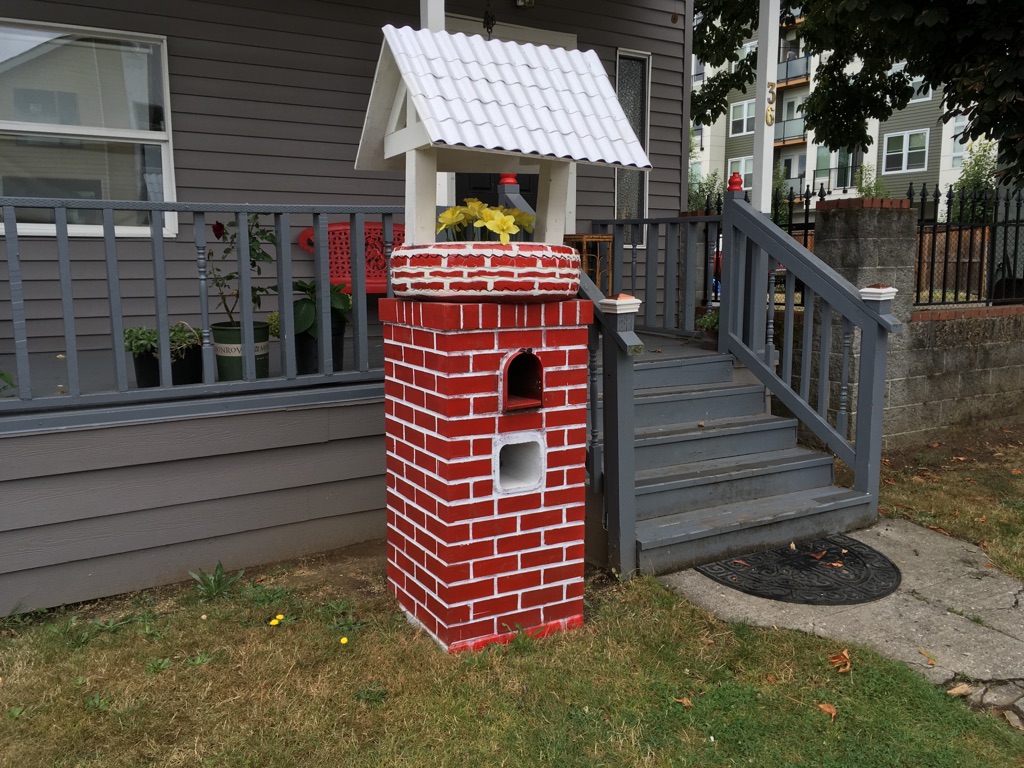
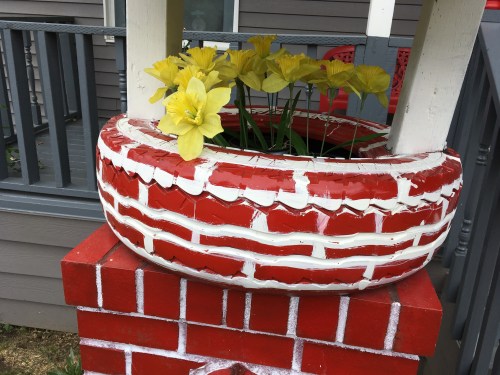
Off North Williams I found a painted tire being used to form the basis of a combination wishing well and mail box. This piece is hitting on many cylinders with that winning and functional combination. It helps that the tire incorporates a faux brick finish and a flower arrangement.

tire art close up

Tire Art, up close!


Desperate Times

Tire Art 5

I’ll have the five stack.

A desperate attempt to glean some semblance of Tire Art can be found in this photo of a stack of tires. There’s paint but the haphazard application is more slap dash than abstract. The only way you’ll get Tire Art from this piece is through a hefty dose of imagination. I tend to take pictures and analyze later as I’m excited to see tire arrangements whenever I can. This is a nice stack with color flourishes, but no amount of photographic trickery could up the art quotient.


Tire Art King

Stack attack.

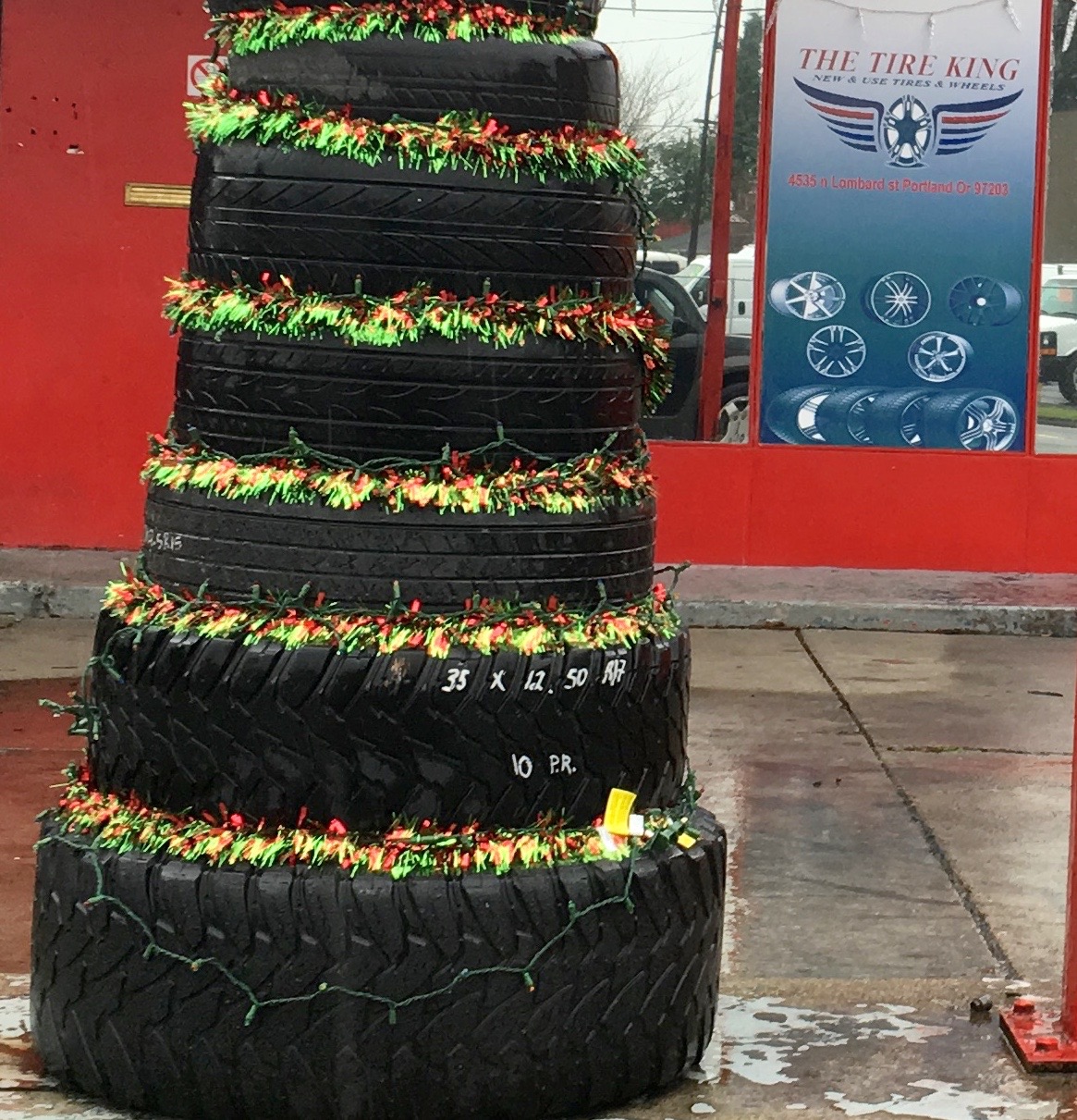
The business on Lombard Street is known as The Tire King for a reason. If nothing else, they’re the king of Tire Art. They’ve displayed tires in many different ways but this set up caught my eye with it’s use of lighting and multicolored garland. It’s festive, cake shaped and an artistic way of creating a sculptural tire advertisement.

Treading lightly.


Color Me Impressed

All in a row.

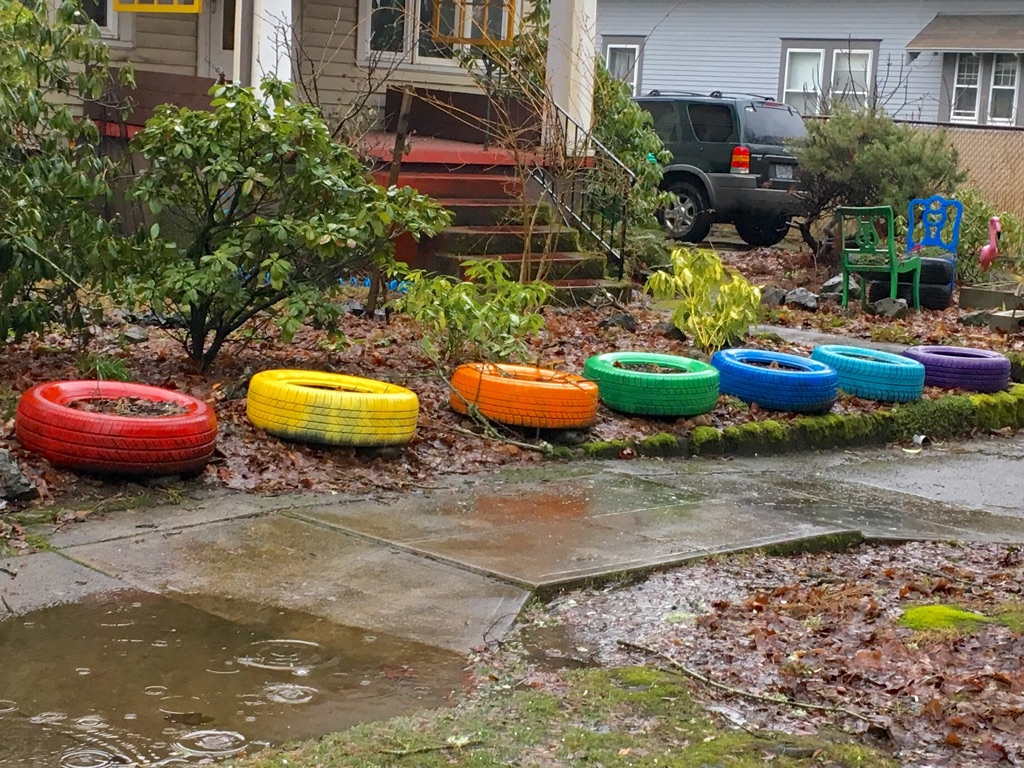
This display created excitement by simply being at the top of my street in the Kenton neighborhood. It’s Tire Art close to home offering rainbow bright colors, though not quite in ROYGBIV order. These tires brighten up landscaping and are now doing double duty as planters. This display truly hits on many of the tenants of high Tire Art involving paint and imaginative arrangement.

Remove hubcaps, add plants.

Part two of our Tire Art series will run next week as we wait for the photos to get back from the developer.

Next week: Creepy Stairs, Not Stares

Portland Has A Liberty Bell (Replica)

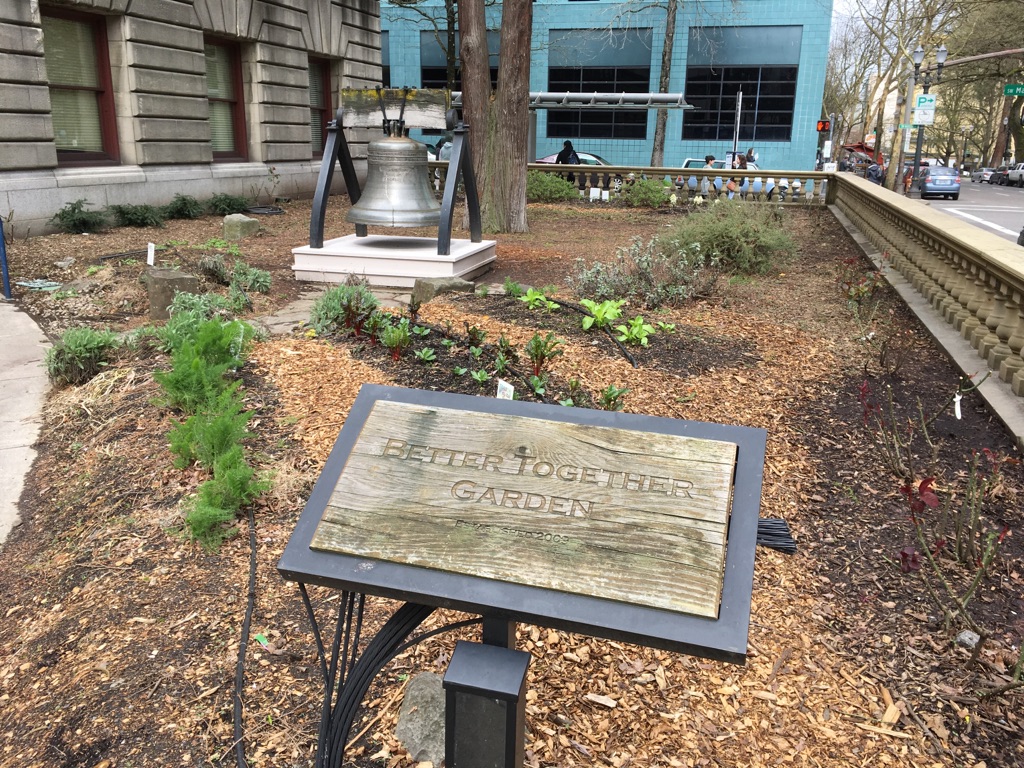
No sooner had I stepped out of the Edith Green-Wendell Wyatt Federal Building, in downtown Portland (after photographing the Louie Louie sculpture) than I ran into a large bell behind City Hall. It looked familiar. Something told me if I got closer, I would see a crack, and . . . sure enough. It hit me: replica crack equals Liberty Bell Replica!

Single word questions like “What?” and “Why?” jumped into my head. Since I was writing posts related to “Louie Louie,” I decided to run the imitation bell up the proverbial flag pole by posting a picture of it on the “Hidden Portland For the Curious” Facebook page as a kind of subliminal, secretive blog post preview. Responses included information from a Wikipedia entry, ah, the speculative journalist’s favorite source, and a link for a site explaining an effort to get a replica placed in each of the 50 states. Most liberty bell replicas were placed in state capitals including Salem. This left me wondering why Portland has a bell.

My best guess is Portland’s bell has nothing to do with the Liberty Bell Replica program that started in 1950. Salem got a bell, and Portland likely developed bell envy. Personally, I like Liberty Bells and had an opportunity to visit the mother of all Liberty Bells in Philadelphia years ago with Pittsburgh Orbit founder Will Simmons. It was great to discover this replica after living in Portland for almost ten years. I never had a reason to hang out behind City Hall until now. My online research proved treacherous, fraught with temptation to purchase my own personal Liberty Bell Replica. I’m surprised the market for them isn’t growing. Portland’s first bell only cost $8,000 in 1962 according to Wikipedia. That was a bargain. Every town and city in America should have its own  Liberty Bell Replica and let freedom ring!

Liberty Bell 2

Will Simmons and some posers.

Liberty Bell 1

You can look and touch.

The Wikipedia entry made fascinating reference to the explosion of the first replica.  After a time in the City Hall Rotunda, it was blown up with dynamite in 1970. An article in the Portland Mercury included details of the bell explosion in a cover story featuring famous explosions in Oregon history. Other articles drew my attention as well. I appreciated a quote from a City Hall custodian, in The Chicago Tribune. “It scared the _______ out of me!” he said. The Tribune published the blank in place of what must have been a vulgar word.

After exploring every source I could find in a fit of harried research, I felt I was reading the same story over and over. The bell was blown up. It was replaced. Not one mention of the reason it showed up in the first place. On Waymarking.com I saw a posting by HappyFrog that tells an interesting tale.

“500,000 schoolchildren signed a petition in 1915 asking Philadelphians to send the Liberty Bell to the Panama-Pacific International Exposition of San Francisco. The Liberty Bell was now to travel cross-country by train, stopping frequently as it made its way to San Francisco. One of the stops was in Portland, Oregon.”

It’s possible this bell commemorates the real Liberty Bell’s 1915 visit, but I didn’t find evidence of that. HappyFrog was told, on a visit to City Hall in the ’60’s, that major cities were given replicas of the Liberty Bell. So they were just handing out bells back then?

I only wish I could reveal the identity of those involved in blowing up the original replica. That would be a scoop. Portland Mercury contributing writer Joe Streckert asked if such a thing as an “original replica” could actually exist. It is pretty oxymoronic as the description of Portland’s first bell. It seems further proof of how much the city wanted a bell when they replaced the first one. It was in too many bits and pieces to put back together. In my research I also learned that the Oregonian uses Wikipedia as a source which puts me in good company.

The Tacoma Weekly reported in 2010 that,

“Fifty-five exact replicas of the Liberty Bell were forged in France in 1950 and were distributed to each state and Untied States territory as part of a savings bond drive undertaken by the U.S. Treasury.”

And yes, the Washington state bell can be found in Tacoma which makes the workings of this giveaway questionable. I’m left, sadly, with more questions than answers. I can’t tell you why Washington State’s bell is located in Tacoma and not Olympia. It is located next to a state building. And no, I never did find the reason Portland has a bell. I hope to have an answer in a future blog post. I can only appreciate the serendipitous joy of happening on the bell. It’s a bonus that its history includes a strange tale. Even the Portland Liberty Bell Replica is trying to keep it weird.

This one stumped me enough that I wanted to share everything I’ve found out about this bell. I received another great link from a Facebook commenter that ties up a few of my loose ends. This may save me from writing more about this unless I can solve the crime of who blew up the first one.

https://cyclotram.blogspot.co.il/2014/01/liberty-bell-portland-city-hall.html?m=1

There’s a Liberty Bell museum, not in Philadelphia, but Allentown, Pa!

http://libertybellmuseum.org

Some guy has gone nuts and is trying to visit all 50 of the Liberty Bell Replicas:

http://tomlovesthelibertybell.com

Next week the first part of an exploration of Tire Art.

The Louie Files: ’62 Seaside Riot

When I started running blog posts about “Louie Louie,” I discovered some history along the way. In the case of finding the location of the Pypo Club, I’ll admit I was befuddled. The origins of the Kingsmen’s recording could be found at the Seaside, Oregon club. While the Pypo Club was not central to the ’62 riots, when discussing this history with my friend Jeff Dodge he told me his father Stew Dodge had been a witness to the event.  I knew there was more to this era to cover. Stew Dodge has been a longtime Portland musician and behind the music scene too through the sound company he owns. I’ve never been to a riot so I had to hear a first hand account.

July 1962

In the summer of ‘62, I was headed for my senior year of high school at North Catholic which is right down the street. Now it’s an Arby’s on Lombard Street. Our family hung out at the beach. We had friends that had a cabin at Tolovana Park. It was a beater, neat, great, beat up five bedroom beach cabin and we’d rent it before school started for a few years. We hung out at Cannon Beach a lot, went up to Seaside hung out there a lot. In the summer of ‘62 I was down there with, I can’t remember probably staying at the cabin in Tolovana Park. I think it was probably a Saturday night and we went in to Seaside. We had a great beach party going. It was Pete Dressler and Al Kemmer. There was maybe four guys and three of the foxiest chicks that ever went to North Catholic High School and I actually struck up a conversation with Fran Yohn who was absolutely fantastic and I had high hopes until the Seaside lifeguards came walking down the beach. Pete Dressler got beat up. They threw the guitar in the fire, drank all our beer and then split. Nobody got really hurt. It was a power move. It was the lifeguards. There was a guy, his nickname was, Hodun, a big guy and there was another guy I’m not going to mention his name because he was kind of the head lifeguard and the next day I went down to the Turnaround I think with Al Kemmer and these guys were hanging around the lifeguard tower, strutting around and they made some crack “hey you have a good party last night.” And I said, “No, we didn’t have a good party at all.” I said, “But you’re gonna wish you never did that because Labor Day weekend I’m going to bring all my friends down here and we’re going to get even with you.” So file that away.

Stew Dodge, far left from US Cadenza band lineup, 1966

Saturday, Labor Day weekend ‘62

So we found ourselves down at the coast, oh there was half a dozen guys I was down there with. Things started getting really crowded and really crazy. It was just huge, packed, you had to walk in the streets because the sidewalk’s too full. This is one thing the good residents of Seaside probably don’t want to admit but I was 17 and I looked like I was 12 and I could walk into any one of three or four taverns buy a case of beer as long as I took it down on the beach on the sand, as long as I went down to the Turnaround and then went on down to the beach. Well let me think. Is that a good idea? Maybe not. So Saturday was pretty crazy, there wasn’t any aberrant behavior I don’t think, it was just packed and a huge party.

The day of the riot, Sunday, Sept. 2nd

The Times Theater is on Main Street and it’s like a long block away from the Turnaround, I think it’s a four way stop now with the light and we were just walking up and down the sidewalk and hanging out and a fight started. As I recall it was a guy who went to University of Oregon and somebody else said the other guy was a javelin thrower from USC or something and it was like a John Wayne movie. These guys were slugging it out. It was a fair fight but it was a real fight. Everybody backed up so there was like a 20 foot diameter ring right in the middle of the intersection where these guys were fighting. Everybody’s cheering them on and finally they said, “Do you want to quit?” “Yeah I’ll quit.” And they shook hands and walked down the street to get a beer and then the cops showed up. I can’t remember why, one guy got arrested and they cuffed him, threw him in the backseat of the squad car and they were already headed up Broadway towards the Turnaround so they drove up to Turnaround and the crowd followed them. They tried to take a right hand turn at the Turnaround and they couldn’t move it was too many kids. It was really packed and people were yelling, screaming and cheering and stuff and drunk, everybody’s drunk. You know the average age seemed to me to be 21 or 22 older and younger, but college. I was kind of in the minority. I was a junior in high school. Somebody, and I was right there I was watching it, somebody ran up and opened the passenger side, back door on the cop car and they grabbed the guy that was in the cop car and spirited him away. All the sudden they didn’t have their prisoner anymore. So one of the cops slammed the door and they both hopped in and they went up to the corner took a right headed back into town and then when they got down in front of the Catholic Church a block down the street they couldn’t move again.

A bottle like this?

It was too crowded. I was standing there with hundreds of people, the cops were, “Okay, break this up, let us through here,” and from kind of up the street towards the beach came a Blitz Weinhard stubby bottle through the air and punched out the rear window of the cop car. And that was it. Everybody kind of went, “uh oh,” that’s all changed and the cops were able to get into their car and take off and we didn’t see another cop, I’m thinking this was five o’clock in the afternoon, six, somewhere in there, we didn’t see another cop for two or three hours, nobody, no authority at all. They all just gave up which is probably a good idea. By this time they started calling in county, state cops, cops from Astoria, cops from all the agencies up and down the North Coast. So it was just anarchy, you know. It was thousands of kids, nobody in charge, everybody is drunk, everybodies’ having a great time. So we’re all back up at the Turnaround and Al Kemmer says let’s get some guys let’s get three or four guys and let’s start chanting, “Let’s get the tower.” Statue of limitations, okay, I’m not afraid now you know I’ve lived my life. And they did. The thousand people streamed down into the sand and pushed over the lifeguard tower. It was like two and a half stories tall and it was right next to the Turnaround so a long way from the water and we thought well that was interesting.

Then about fifty people picked it up, carried it up the steps and stood it up in the middle of the Turnaround and I’m thinking this is interesting you know this is getting out of control and then they started rolling it end over end down Broadway. It took like fifty guys to do that. It was spectacular and I’m think it pretty much disintegrated from falling over a bunch of times in the cement and then the cops started coming up the street and a fire engine. A fire engine came up about a block away from the actual Turnaround, maybe, and they hooked it up to the fireplug, fired that thing up and got their high pressured hose, I think they only had one, they might’ve had two hoses. They had at least one hose and started hosing down the crowd, which was great fun, you know, and again it didn’t start getting crazy until firemen and cops and other people with some sort of authority in Seaside started using ax handles and they started beating on the kids and then arresting a lot of kids. My good friend, he grew up two houses away from Pat Daily, he went to jail that night. They got him for inciting a riot, hauled him off and put him in jail. We bailed him out the next day.

There’s a picture of a guy, with a newspaper holder, I was right there, I watched that. He tried hitting somebody with that. And then the water stopped the hose quit and a guy, a kid, came running up the street with the keys to the fire engine in his hand, a huge cheer, right. It got tough after that. It got really rough. There was lots of cops. I don’t think the National Guard made it there that day. I think they were there the first thing in the morning. They called up the Guard and that was pretty much it for the anarchy, the thousands of kids from up and down the coast. Three or four of us walked out of town to Gearhart, which is the next town north and we all slept in a barn. I don’t know whose barn it was. It was Labor Day, it got pretty chilly that night but I can remember all of us slept in the hay in the corner of this barn because all of the highways were closed so we couldn’t get anywhere. That’s the chronology from my memory.
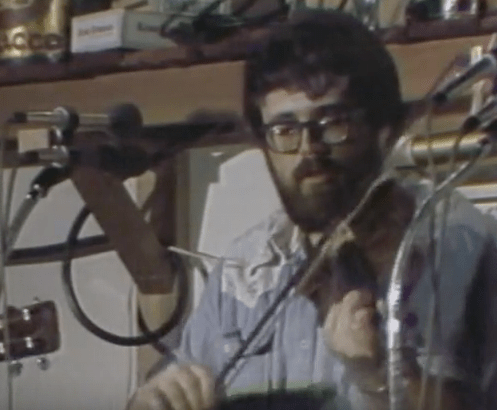
With Dr. Corn’s Bluegrass Remedy, 1976

PO: But the cops left and you guys kind of were set off what kind of rioting was going on right as the cops left? Was it fighting?

No, it was a party. It wasn’t even edgy, you know, it was a party. I think the seamier element, I think that’s when stuff started getting broken, and I wasn’t up on Broadway when they were breaking windows and stuff and I think that was, I can’t really remember if that was before the reinforced Police got back up the street. It may have been. With the fire engine, that was great fun getting hosed down with water but they were gone a long time. My feeling was that it was still a giant drunken party

Fritz Richmond’s Barbecue Orchestra, 2003

PO: Combined with maybe some underage drinking.

Some!

PO: But you mentioned the older crowd too, 21 to 22 mixed in with high school kids.

There was wholesale drinking. They were lined up in the bars buying cases of beer and then going down to the beach.

PO: As far as those lifeguards, did you ever catch up with them?

Yeah, the next day. We walked down there, me and half a dozen of my buddies walked down the steps and there were four stakes in the ground and they had it roped off where it used to be. I thought that was a wonderful memorial. It was suggested that it would be a really good idea if we got the hell out of Seaside right then and we did. That was Labor Day, that was Monday. I didn’t press it. I didn’t want to get something going all over again but I was able to look at the stakes in the ground and smile at them.

US Cadenza reunion, 2013

PO: You pretty much got the last laugh because their stand had been destroyed.

And then twenty-five years later or thirty years later, I was hanging out with this girl who lived in Cannon Beach and her landlord was the guy. I think his name is Dick Donica or something, he was the head, he wasn’t the big tough guy but—these guys, they’re all king of the Pypo Club and stuff. They’re real celebrities in Seaside and insufferable jerks. And he was Maggie’s landlord at the house she was living in, in Cannon Beach and this was in ’90, ‘91 maybe, and I knew who he was and I ran into him a couple times and he kept going, “Do I know you?” This was 30 years later and I was like, “No I don’t think so.” He looked at me funny and said that two or three times over that summer.

PO: What are your thoughts as far as Seaside not wanting to talk about it?

It’s funny because in the mid-70’s I worked at a place and one of the guys I worked with, the guy worked out in the warehouse, Sonny was the guy’s name, he was from Seaside and he was there during the riot. It came up once and they’re all pissed off that it gave Seaside a bad name, yeah, sleepy little beach town.
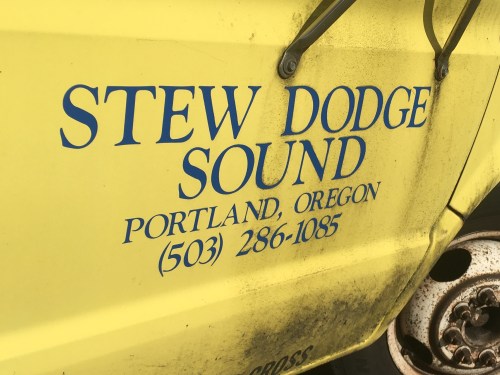
A sound idea, indeed.

PO: I mean part of my thought is it was right before I was born but I think about back then you think, early 60s everybody’s respectful, for this or that you can think about the Marlon Brando types the Wild Ones or something it’s not a biker gang thing but,

No, and that wasn’t, if you look at the pictures, I’ve been looking at the pictures and actually I’ve been seeing guys and I’m going okay I remember that guy. I don’t know who was at fault to do things over again that kid shouldn’t have thrown that beer bottle. Maybe they shouldn’t have arrested that kid. They’re trying to do a big power play in front of a thousand drunk college students, maybe that wasn’t smart. Nobody down there, none of the cops, sleepy little Seaside town, the worst they’d ever done was roust a drunk or a bounced check. This was totally new ground for them so it was a comedy of errors I think and there wasn’t, except for the tower, there wasn’t any sort of pre-planned thing so it was not a conspiracy it was something that got out of hand.

Performance photos courtesy of Trench Digger Productions. Many thanks to Jeff S. Dodge and Mr. Stew Dodge, too!

More reading:

http://www.oregonlive.com/history/2016/06/seasides_wave_of_riots_in_the.html

My favorite part of the link below is how the photo is debunked by the commentators:

http://www.stumptownblogger.com/2011/05/the-seaside-riots.html

Next week: Portland has a bell?
Doldrum Shake Ups: Sign Additions

Municipal signs lack something. The design aims to present information and educate the public so it needs to be eye catching but not fancy. These signs have no fear of boring anyone. I’ve mentioned in this blog that I read everything, except the fine print and the manual. I’ve been rewarded with discovering signs sporting interjections of added art by unknown artists and unsung heroes giving a bit of personality to these morbidly mundane municipal messages.

Fat Cat Walking

Some signs not only spell out their message but illustrate it as well. That’s where the fun of this downtown Portland sign begins. This is not a stretch of sidewalk for loitering. Don’t stand around or you’re liable to get trampled by a diverse horde. You might be strolled, rolled, tripped over, poked by a cane or suffer a giant cigar poke to the eye. Wait a minute, that cigar wasn’t part of the original design. How fantastic is it that someone decided this sign needed improvement? Not only did the culprit risk getting walked over when decorating the sign, they actually nailed it. If you can imagine the figure minus the cigar and top hat, the man is joining this procession in full Fat Cat stride. Admire the coolness, the back lean, hand in pocket bravado adjusting his pace as not to crowd the cane bearing slow walker in front of him. What Fat Cat should be without a giant cigar and top hat? Keep puffing along Fat Cat, if you weren’t so relaxed and cool, I’d expect to see you in the front of the line.

Walking the Dog

While the Stick Figure Guy has been the butt of many jokes in his time I’ve never had a problem with him. This floating head, handless, footless, jumper wearing dude has always represented a person doing what the sign communicates his figurative needs to be. In this case the man is trying to cross the street. The sign includes a shout out to dog walkers on SW Capitol Hwy. As a dog walker myself, I welcomed the acknowledgement of the dog walking chore. Of course dogs need to cross streets too. Why were they forgotten in the first place? Our unknown artist missed an opportunity to draw the dog in stick style although why would anyone, there’s no stick breed. Dog walking in this case is challenging when you consider that Stick Guy has nary a hand and not much of a wrist to hang a leash on.

Danger Boy

This sign on Interstate Ave. reveals another dramatic development in the life of a Stick Figure Guy. A bolt of electricity strikes deep into his inky insides from a broken wire as Danger Boy looks on. The additional drawing offers an example to Stick Man on how it’s really done. To avoid danger simple choose to sit far away from wires. With his big eyes, Danger Boy remains wide eyed, mouthlessly silent and alert in the face of all treacherous situations. He’s doing double duty filling up a serious hole of white space in a sign that suffers from a poor design.

Where the Streets Have No Name

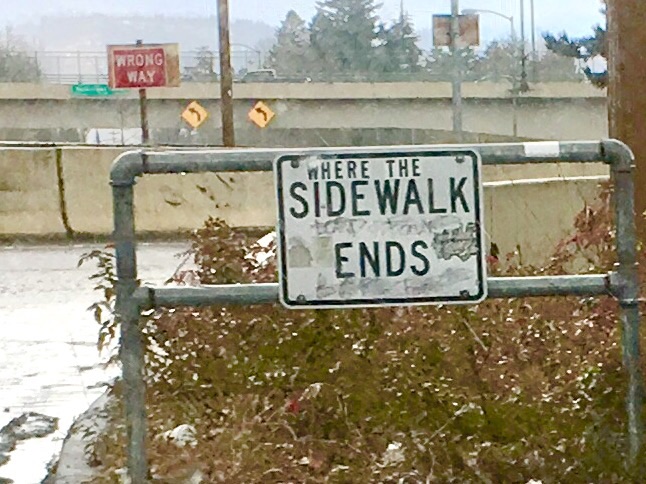
Outside a bus stop on Barbur Blvd in SW you’ll find a street sign addition that seems to call out mournfully the absence of something, well, absence. It’s true, as the sign feels the need to say, after those gaudy iron pipes there’s no more sidewalk. How would that not be obvious to anyone who might encounter it? After a few steps and a look around someone might try consider where the sidewalk went but the sign has additional information that’s let them know the exact point where the sidewalk ends. Equally important as questions go, who felt the need to add letters as if the original message on the sign wasn’t interesting enough? Someone out there was inspired to add the necessary flare supplement the sign’s plain design. It now takes on a kind of existential quality. Thankfully the effort was made so a few bored commuters, some daring pedestrians and an urban explorer or two might have an opportunity to be shaken out of their doldrums.

6/7/17 Weeks later I was embarrassed to find out via the Hidden Portland for the Curious Facebook group that this is a reference to a Shel Silverstein book. I work in an elementary school so I know I’ve seen those books around but I was more of a Tom Lehrer fan.

I got a synchronous tip from Cupcake Macfarlane about the work of the Billboard Liberation Front.  Check it out!

The Louie Files: Louie Louie Sculpture

I never would have known there was a “Louie Louie” sculpture in town if I had not been tipped off by Willard Simmons. Willard enjoys his fame as a blogger for the Pittsburgh Orbit and I was lucky to have him as a guest columnist. Earlier this month, he wrote about the greatest moment in rock history and had been looking for photos for the post. If you haven’t read it already it was about the 60’s Portland band the Kingsmen recording “Louie Louie.” I ran the post on April 6 in honor of the 54th anniversary of the making of that record.

A closer look.

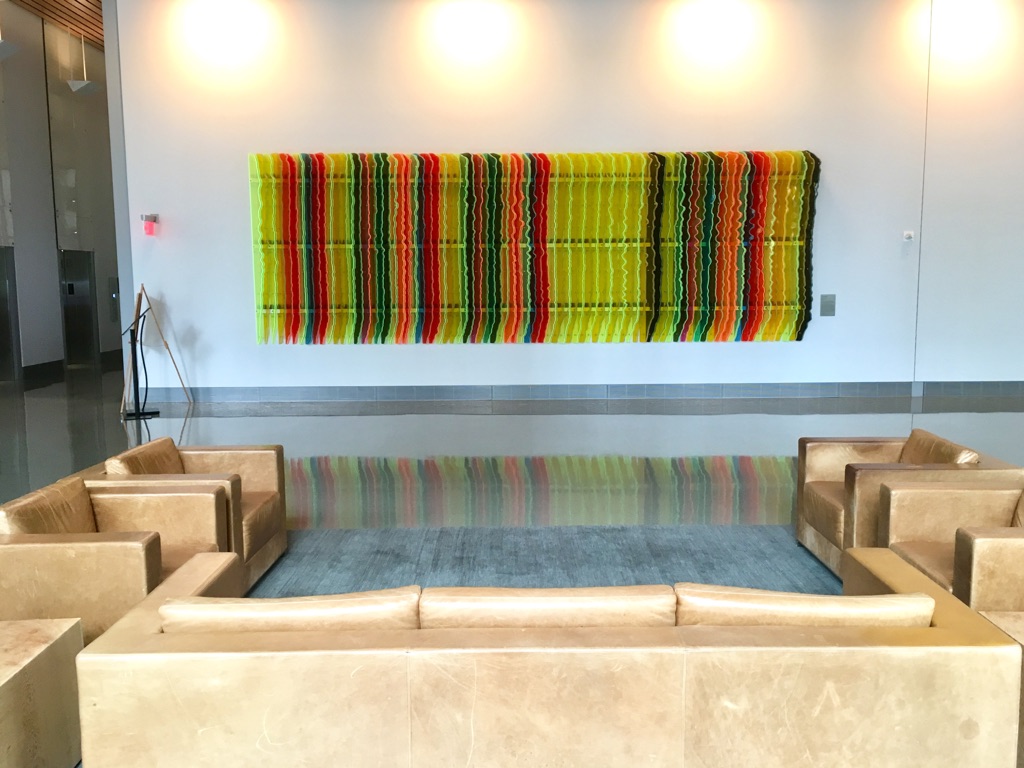
You have to make some considerations when you’re attempting to illustrate a song. It’s challenging. Artist Tim Bavington illustrated the song’s sound waves in a sculptural form  that hangs in the lobby of the Edith Green-Wendell Wyatt Federal building at 1220 SW 3rd Avenue in Portland. You pretty much have to have synesthesia to make an image of music and yet Tim Bavington’s sculpture takes the notes and chords from the song “Louie Louie” and does that. My research revealed that the sculpture replicates the Kingsmen’s version of the song but unless you’re a sound engineer with a keen eye, as opposed to your average federal worker, how would you know?

The Louie Files: Louie, Louie Sculpture 3

I made my way downtown on a Tuesday afternoon during my spring break. With a sneaking suspicion that a federal building meant security, I emptied my pockets of various odds and ends before leaving the house. I was getting worked up knowing I was going to have to explain my mission. When I arrived I told the guard about my blog related photography assignment. I wondered if I sounded professional, or crazy. He remained unfazed, as if this were an everyday occurrence. I was instructed to only take pictures of the sculpture and not the security apparatus I was passing through. Taking off my shoes only proved to be a minor annoyance. It was getting me closer to the sculpture. I discovered the plate in my arm from this summer’s bike accident didn’t set off the metal detector.

The guitar solo is the yellow part.

After collecting my belongings, one of the other guards told me, what sounded like a rumor, that the art was hung upside down. I was flabbergasted. Art hung upside down? I asked why no one ever returned to hang it right. She explained that she had worked in building construction and thought the art work cost more to hang than to make. Rearranging it would be cost prohibitive. She seemed like a good source of information so I asked how the art work ended up in a Portland federal building. Her explanation was cryptic. She told me she had lived in Portland for a long time and wacky things happen here. Days later I had to wonder if I had not fallen victim to the greatest joke about abstract art of all–the old nobody knows which side is up joke.

The Louie Files: Louie, Louie Sculpture

Feds in there somewhere.

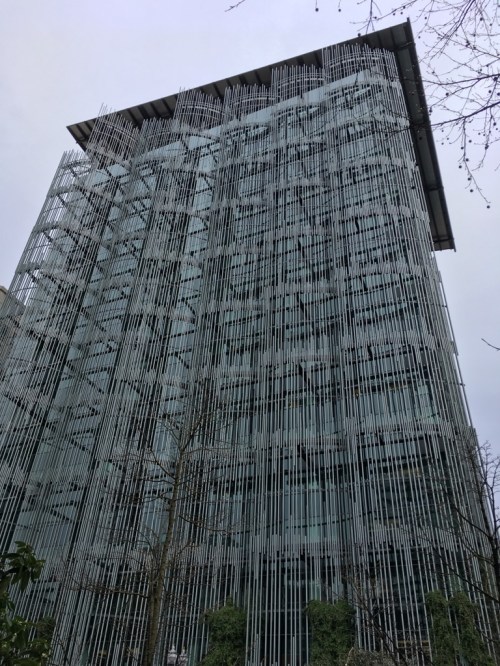
The Federal Building itself is a work of art. Ironwork up the entire building had me wondering how this obscures people’s views from the windows but it sure looks cool. Inside the lobby, the “Louie Louie” sculpture is given a great amount of space, the whole lobby, minus the security apparatus, to be noticed and admired. The large windows on the ground floor allow light to be reflected back on the surface of the art work. I found this distracting because it doesn’t allow the color of the sculpture to be seen as well but it adds a dimension to the piece. It’s always going to look different. That sentiment was summed up in the title plaque that describes how artist Tim Bavington:

“assigned colors to spectrographic images of the music, and the resulting color combinations correspond to the song’s changing chords. Viewed from different angles and in shifting light throughout the day, the forms appear fluid and ever-changing.”

Seating for seven.

Another detail I appreciated was how the art reflected off the shiny floor, mirrored in swirls of color. I laughed to think about how there was seating arranged far from the art work with enough space between to take the whole thing in or not look at the sculpture at all. I had to wonder if people considered the artist’s methods, design and subject matter and if the art ever started discussions about the song itself.

Detail

The song has taken on a bit of a new life for me as I started this series of blog posts related to it. I never quite caught on to the “Louie Louie” resurgence in the ’80’s but after reading about the “Louie Louie” marathons at California college radio stations it now makes sense. I finally got around to visiting the building where the song was recorded. Next year I hope to write about the plaque being returned to one of its walls. I heard it had been stolen but was told when I visited the site that it was taken off for renovation work.

IMG_4979

The Louie, Louie Building sponsored by FedEx.

Mostly I like the idea of a bunch of guys bombing into a recording studio and being bum rushed into churning out a quick take of a song that became legendary. One Facebook responder didn’t think the guitar solo was raunchy enough and while that’s something to consider, the song was recorded in a way that created a delicate balance, anything done even in the slightest different way, another take or an overdub (if that technology even existed then), might have thrown off the whole recording. As Simmons described in his greatest rock moment post, the Kingsmen created a recording full of “magical quirks,” a phrase that relates to the possibilities that can still be found in Portland. Somehow it all seems subversive in a subtle way that a sculpture would be installed in a federal building fifty years after an Indiana Governor alerted the F.B.I. and started a rock and roll witch hunt of sorts over the song’s perceived explicit nature. I’ll take quirks anywhere I can find them even if it means taking my shoes off.

Next week’s topic will be Sign Additions. You’ll have to tune in to see what this is about. The following week we’ll be running the last of this year’s Louie Files series. We’re thinking it will be a first hand account of the Seaside riots.   

For sculpture information see:

http://www.oregonlive.com/portland/index.ssf/2013/07/the_kingsmens_infamously_innoc.html

Many thanks to Louielouie.net for their “greatest moment” write up:

http://www.louielouie.net/blog/?p=8424

The Louie Files: Finding Pypo

There’s plenty to do at the Oregon coast, even during a rainy weekend. There’s bad cable television, waves to look at and listen to and rain showers to dodge when the time seems right for a walk on the beach. But I was on assignment. No, I hadn’t gone to Seaside, Oregon for the sole purpose of hunting down the remains of an old teen club but since I was in the area, the exact area, I knew I could make it part of my agenda. I was really in Seaside because my wife, Ronna, was attending a conference at the Convention Center. My real assignment was to monitor the dog and keep him from barking and waking everyone up at the hotel.

When Will Simmons from the Pittsburgh Orbit was preparing a post for this blog to celebrate the anniversary of the Kingsmen’s recording of “Louie Louie,” I read the story about the origins of the song and kept hearing about the Pypo Club in Seaside. I was in the right place to snap a few photos of the place that played a part in the song’s history. By now, hopefully, you’ve read Simmons’ “Louie Louie,” post. The Pypo Club was integral to the Kingsmen’s association with the song. It was at the club where the band kept seeing kids get up and dance to Rockin’ Robin Roberts’ version of “Louie Louie” every time it came on the jukebox. This inspired the band to perform it themselves. Obsessives like me find this moment of inspiration historical. It led to the Kingsmen recording “Louie Louie.” Historical events mean building preservation and plaques. I knew the club was on Broadway so after walking to the Convention Center the night we arrived I found the street which is the town’s main drag and headed towards the ocean. I expected to see the Pypo Club looking familiar like the old photo I’d seen but the darkness kept it hidden. That was okay since I had the next day to find it.

The Club keeps you young.

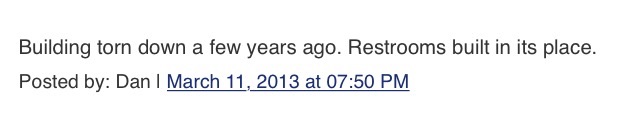
The following morning I did more research. I read the obituary of the man, Gil Tolan, who co-founded the club in 1961. The Pypo Club got a brief, one sentence mention. The gentleman had a full life so the obituary explored his many other accomplishments. Then I discovered that the first Pypo Club was torn down. This club had figured so prominently in rock history and yet I could find few specifics about it. Some Facebook mentions seemed concerned with casual reminiscences. Somewhere a comment explained the building’s demise.

A commenter tells the tale.

With all the development that had gone on in the last 50 years it made sense that a teen club would be inconsequencial. Right there at the point where the Pypo Club would have faced the ocean was a concrete bunker complete with a roundabout for auto traffic with a statue of Lewis and Clark in the middle. Underneath this were the public bathrooms. Additional research revealed the club had moved to a second location in a building that became an electrical business. That too was torn down to make room for a parking lot. I never determined when that happened. I was sitting in a hotel room like I’d been bowled over by a rouge wave. I had nothing to photograph. There was no way to capture the Pypo Club aspects of the “Louie Louie” story.

Possible Pypo Club site now bathrooms.

I thought I needed to go to the electrical business named Borland’s. They had moved into the second Pypo Club on A Street. That business then moved to G St. I’m not sure if I had a specific address other than the street name but I was thinking that the town was small enough that if I drove up and down G Street I’d see it. I imagined a back office with photos of old buildings and stories about rock and roll legends but I never saw the business. Surely the internet would have told me if the business was still around and if they had weekend hours, but I missed the part where the business was actually located in Gearhart. I regrouped because I knew I had spared someone, and myself, some awkward and over-caffeinated blubbering about being a blogger hot on the trail of a rock club who’s name I couldn’t even pronounce.

History is made here.

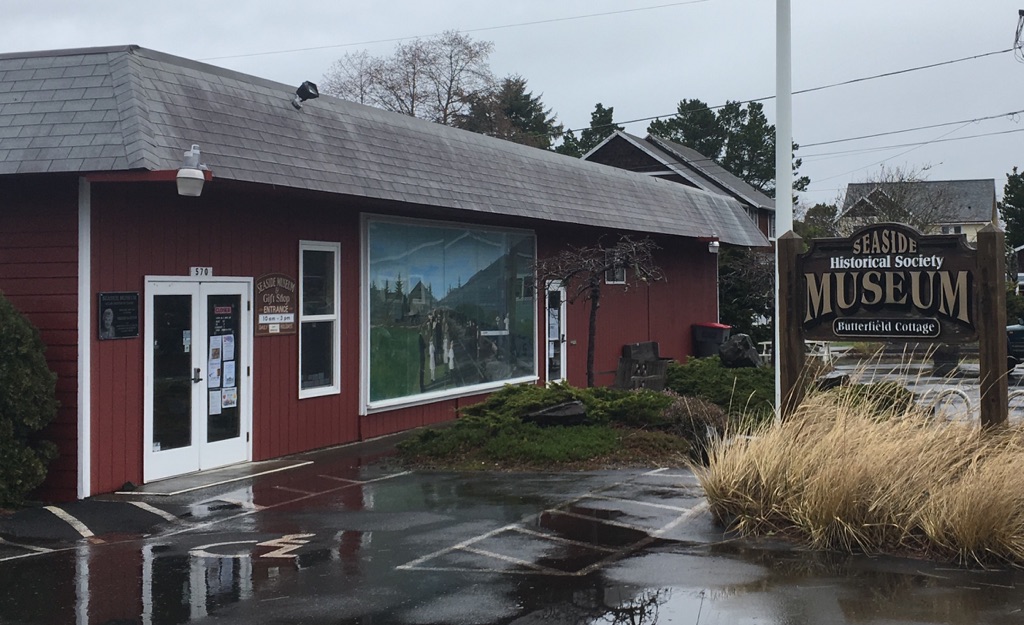
I remembered seeing a sign for a historical museum in the area and I headed back to find it. Walking in and seeing the sign for the 3 dollar entrance fee had me telling the man at the desk in the entrance way, “I don’t have any money but I’m trying to find information about the Pypo Club.” I still wasn’t sure how to pronounce it so I said it both ways, “Pee-po” and “Pie-po” to be safe. I explained that it was an old rock club where the Kingsmen and Paul Revere and the Raiders played. He said he hadn’t heard of it. I think I babbled a bit about what I knew about the buildings being torn down. I mentioned the ’62 riots which were associated with the Pypo Club. He seemed to know about that. Then he disappeared into the back and brought out an old phone book. I would have preferred he bring out an old timer they had stashed in the backroom with exstensive knowledge of the town’s early rock years. After going back a couple of times, he found a phone listing in the 1963 book. He had spent a few minutes looking the club up under the letter U. The photo I showed him had “Under 21 Club” on the awning.

The Louie Files: Finding Pypo 5

There’s that number, again!

I’ll admit it was a bit confusing but I realized Seaside had more history going on than what happened at the Pypo Club and there was a whole museum devoted to it. The volunteer was younger than me but I was still mystyfied. I mean the Kingsmen, “Louie Louie,” the germ of an idea had happened in Seaside. Why wasn’t it a bigger deal? Why didn’t everyone know? I took a photo of the listing in the old phone book, evidence that the place existed. I left wracking my brain about what else I could photograph, but forgot to take a picture of the museum. I made my way back to A Street and took pictures of the empty lots across from the Dairy Queen the man at the museum told me about.

Not in the area of the second Pypo Club.

The next morning I realized I could go back to the old address of the original club, 1 N. Broadway. Here’s where I remain confused. Either I saw the club listed at this address or wanted to think that the address still existed even though the club is long gone. Right there in the phone book it’s listed as 1 Broadway. The thing I got excited about was that with it’s black stripes the awning looked similar to the one in the old Pypo Club. Due to some early morning chaos, my first picture was crooked. When I went to take the picture the dog growled at a man who approached the store then turned away, while out front a woman was having her car towed which wasn’t going to make a nice wide shot. As I was packing up to check out of the hotel, I made plans for more photos. I needed the histroy museum and business at what I thought was the old address or at least a better awning shot. I was in need for a witness to this history but was in no mood to hang out at the local eatery, the Pig’n Pancake restaurant and badger random senior citizens with questions.

That old, familiar awning.

There I was scrambling around, carrying bags in the pouring rain, loading the dog in the car, going back to the room for the last load and dealing with a key card that stopped working. The museum was easy. It was all about waiting for the flag to unfurl just right, but even that ended up getting cropped from the photo. Getting back up Broadway at noon proved tougher than I realized. It’s a small area but traffic congestion combined with the longest red light I’d ever experienced was making me late. I still needed to pick my wife up from her conference. I drove past the market somehow related to the Pypo Club snapping photos and realizing that driving while photographing was probably just as dangerous as driving while texting as I then began to navigate the turn around. I took a deep breath slogged for another block back through traffic and realized that I, at least, had a few more options of photos to tell the story of the Pypo Club a place that’s gone but who’s spirit emanates from the sun, rain, wind blown sand and ocean spray of the resort town of Seaside, OR.

Next time: A visit to the “Louie, Louie” sculpture located in a Portland federal building.

The Louie Files: The Greatest Moment in Rock-and-Roll

exterior of two-story brick building painted black, downtown Portland, OR

Hallowed ground. The former Northwestern Recorders, Burnside and 13th Ave, where “Louie Louie” was recorded.

Editor’s Note: Guest columnist this week is Will Simmons from the Pittsburgh Orbit. His love of the the Kingsmen’s version of “Louie, Louie” has inspired a slew of forthcoming posts to celebrate the 54th anniversary of  the recording. He’s won me over as I realize Will isn’t spewing hyperbole.


It is the greatest moment in rock-and-roll. I can say that definitively–I know them all.

Oh, sure–there’s Jackie Brenston and pre-spousal abuse Ike Turner’s “Rocket 88”, the so-called “first rock-and-roll song”. Elvis, whose famous croon and gyrating mid-section is right up there with the crazed abandon of Little Richard and Jerry Lee Lewis. Chuck Berry is a one-man honors course on the past, present, and future of the genre.

The Beatles launched a million shrill screams and sent inspired amateurs from all over into guitar shops. Their across-the-pond mates The Kinks, The Who, and the Rolling Stones all launched impressive salvos at this hallowed target.

Somebody’s going to argue for Robert Johnson selling his soul down on Highway 61, Sister Rosetta Tharpe’s rock-and-roll gospel, Dylan “going electric”, Janis Joplin’s impassioned ball-and-chain wails, Hendrix on his knees and out of his mind at Monterrey. “Rock and Roll, parts 1 & 2”, Mike Leander’s Frankenstein studio creation for Gary Glitter, was famously called “a castration op where you throw away the patient and keep the balls”. Queen’s “Bohemian Rhapsody” set some kind of high-water mark, but it’s not this one.

We could go on and on–heck, we haven’t even gotten to punk rock!–but what’s the point? No, “Louie Louie”–The Kingsmen’s definitive “Louie Louie”–recorded on this day in 1963, alone holds that title. And it happened right here….er, right there…in Portland.

Tim Bavington's sculpture "Louie, Louie" (detail), Edith Green-Wendell Wyatt Federal Building downtown

Tim Bavington’s glass and acrylic sculpture “Louie, Louie” (detail), Edith Green-Wendell Wyatt Federal Building downtown

Kids today. One thing they’ll never know is the absolute moment of greatest excitement in life. I’m talking about the brief seconds immediately following the record player’s discordant crunch–like a car crash heard from blocks away–as the needle makes contact with spinning black plastic. From that instant until the music kicks in–possibly nanoseconds, a blink of an eye, really–there is nothing except the amplified scratching of dust on empty grooves and a heightened anticipation that something incredible is about to happen.

When the needle drops on “Louie Louie” it has every molecule of this electricity behind it. The organ pick-up on the V chord and one run-through of the progression is just enough warning for rockers to rise from their seats and the timid to dive for cover.

Lynn Easton is a sonic terrorist wanted for crimes ranging from flagrant tempo irregularity to rampant contraption kit abuse. But then as now, there are no normal circumstances and Easton’s all-fills-all-the-time, no-crash-cymbal-left-alive approach to drumming is exactly what you want destroying rhythm in the scorched earth ground war that is rock-and-roll.

What takes “Louie” over the top, though, are the loose, drunk-sounding, shout-sung vocals of young Jack Ely. It’s just one of the song’s many magical quirks that the record was done in a single take, recorded live in the studio using just three room microphones, by a band that only just added the song to their repertoire. When Ely sings through his teenage orthodontal work, craning to be heard over the live band din, he’s working from only a passing familiarity with both the new lyrics and arrangement.

It all adds up to one of the great vocal performances in rock history. No one would possibly practice singing a song the way Ely delivers it. Likely–had the band been granted more studio time, budget, a producer–they might have rethought the spontaneity of this first, perfect take. Fortunately for all of us, they never got that chance.

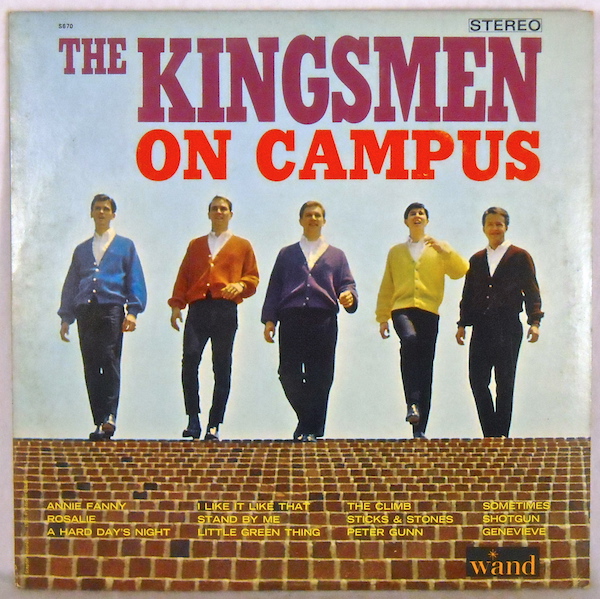
"The Kingsmen on Campus" album cover with five band members in cardigan sweaters at the top of a brick staircase

If the cardigan’s a-rockin’… big Kingsmen on campus (1965)

By all accounts, Ely, Easton, and the gang were pretty square. From the band’s Wikipedia entry, “The Kingsmen began their collective career playing at fashion shows, Red Cross events, and supermarket promotions, generally avoiding rock songs on their setlist.” The group only fell into trash rock ass backwards after hearing the popularity of an already-recorded version of “Louie Louie” while playing at the very un-rock-and-roll venue of a yacht club on the coast.

There are plenty of wilder early rock records that pre-date “Louie’s” moment of glorious infamy, but none that got anywhere near the exposure The Kingsmen received. Coming at the tail end of the brief window between Elvis leaving the building and The Beatles “yeah-yeah-yeah”-ing arrival, “Louie” is the great exclamation point that ushers both popular and underground rock music into the 1960s. When the record peaked at #2, in December, 1963, the Billboard’s Top 40 chart contained such ’50s hangovers as Neil Sedaka, Bobby Vinton, and Al Martino, “Be True to Your School” and “Wives and Lovers”*. The top spot was held by The Singing Nun’s folky “Dominique”, sung en Française.

Seaside, Oregon phone book entry for the PYPO CLUB at 1 Broadway

An old-school phone listing is all that’s left of Seaside, Oregon’s Pypo Club, where The Kingsmen first heard “Louie Louie”.

The Kingsmen went on to record a series of albums in the mid-1960s full of decent, but forgettable R&B standards, dance-craze-of-the-week retreads, and unfortunate novelty tunes. It didn’t help matters that shortly after “Louie’s” success, Easton staged a bloodless coup to unseat Ely as lead singer and frontman. In one fell swoop, the band lost both of their greatest assets–the untrained voice and the unhinged beat.

promotional photograph of Jack Ely and the Kingsmen with band members smiling in jackets and ties

Jack Ely’s post-sacking, hack lineup of The Kingsmen, c. 1964 [photo courtesy of the Oregon Historical Society]

None of these things mattered to me. As a high school student in the 1980s, I bought used-bin copies of all their records and played them incessantly. My peers were listening to Siouxsie & The Banshees and The Cure while I was spinning The Kingsmen’s B-grade takes on Allen Toussaint and Rufus Thomas songs.

Looking back, I recognize how mediocre the Kingsmen’s second- or third-hand, safe-for-middle-America versions are in comparison to the real thing. But those albums served as a great gateway to finding out about much more interesting music–both in the New Orleans/Memphis R&B records they copied and the mid-’60s garage rock they became synonymous with.

The Kingsmen will never be remembered for the catalog produced by ‘60s rock peers The Pretty Things or The Troggs, The Chocolate Watch Band or The Sonics, The Standells or The Easy Beats. But they did one magical, perfect thing–right there at Burnside and 13th. It changed this blogger’s young life and he is forever in their debt. Me gotta go. Aye-yi-yi-yi-yi.

Hyperbolically yours,
Will Simmons
Pittsburgh

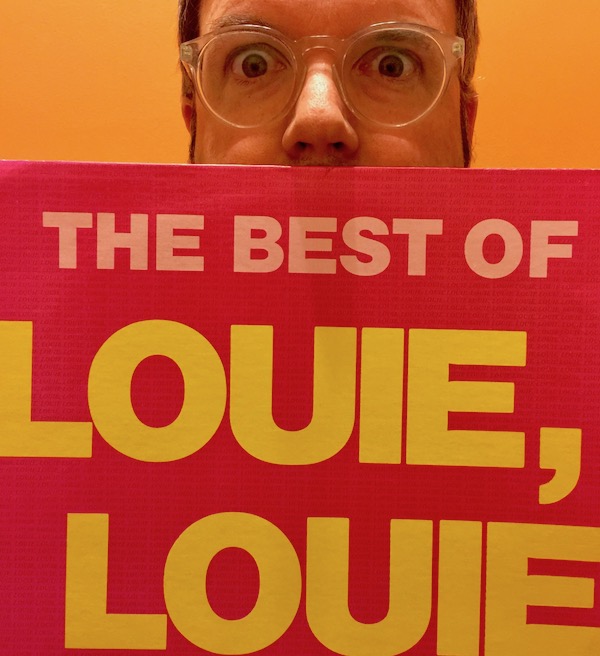
man holding a copy of "The Best of 'Louie, Louie'" vinyl album

The author, one needle-drop from ecstasy


Further reading: Dave Marsh’s 1993 book Louie Louie: The History and Mythology of the World’s Most Famous Rock’n’Roll Song (Hyperion) is a totally great read for anyone with even a passing interest in the song, Northwest rock history, or just a goofy, wild true tale. It’s amazing to me that Multnomah County Library only has one (print) copy in the system considering how much of the book could be considered “local history”, but hey–it’s available! (as of this writing)


* In fairness, the Dec. 14 Billboard Top 40 also contains some pretty good stuff–“Walking the Dog”, early Motown records, “Sugar Shack”, etc.

Next week in the second installment of the Louie Files, we’ll explore an attempt to find the rock club in Seaside, OR that inspired the Kingsmen to record Louie, Louie.


Billbored

I’m a compulsive reader. I’ve admitted that before and there’s probably nothing wrong with it. Lately I’ve found my dwindling attention span has kept me from having an interest in long form publications like books which make billboards perfect reading material. They’re set up to be attention grabbing with big lettering and simple concepts. I’ve read them all, the ones I’ve seen anyway. When I started to notice billboards together with signs that combined to form either a condtradictory message or a theme, I realized I had a concept for a blog post.

The Spark

This is not John Wayne in a movie!

A couple of springs ago, I noticed a coincidental placement of John Wayne’s cowboy claded head peering over the Bison Coffeehouse in the Cully neighborhood, which I have since learned is the only Native American owned coffee shop in the Portland area. It put the idea in my head a long time ago about odd billboard placement that could combine with either other billboards or businesses to form unintended statements or a clash of cultures imagery.

Vice Corner

Time to get busy.

Above the building that houses the Arbor Lodge coffee shop and Revolver bike shop sits a billboard duo that, I’ll admit can be challenging to photograph. I didn’t let it stop me when I spotted two signs together promoting vices, albeit legal ones. There’s an exponential power telling us get high and gamble. Years ago these vices would have been found under more shadowy circumstances, now there’s open encouragement. Whether it’s wise to do both at the same time, well, that’s beyond my comprehension.

Beer & Bar

It’s Miller time.

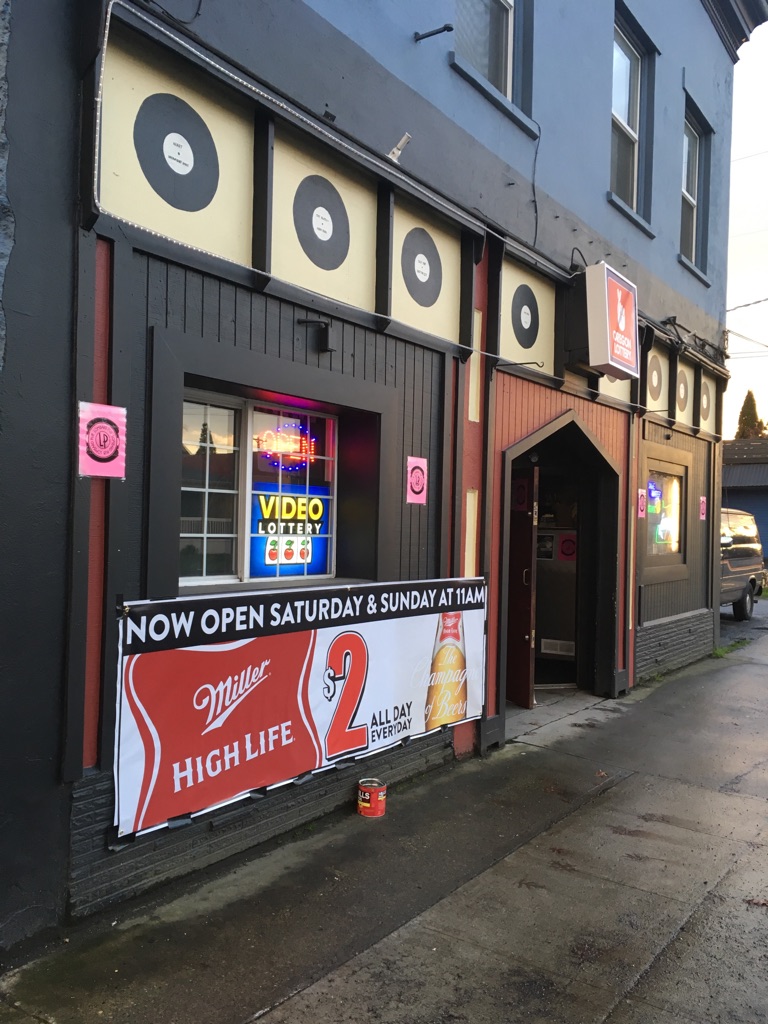
There doesn’t seem anything more appropriate than a billboard advertising beer outside a bar besides maybe an advertisement for a DUI attorney, but that would be tacky, wouldn’t it? Seeing the brand of beer that seemed antithetical to the type of beer sold in most Portland bars had me gearing up for a rare occurrence in my line of blog work–the investigative phone call. It wasn’t until I hoofed it up the street early one evening to take a picture of the Lombard Pub, formerly the Foggy Notion, that I saw the banner sign calling attention to the Miller beer special. Art is reflecting life and there’s truth in that advertising—almost all is right with the universe.

Is it special enough?

Pushin’

Pick your poison.

This billboard jumped out at me the second time I drove past it. The man in the picture is the image of health and vitality that is either proof that the tanning product works exceptionally well or that this gentleman/model/push up performer doesn’t need the product at all!

Jesus & Tequila

Do I have to decide?

These two advertisements appreared to represent a kind of fork in the road made all the more momentous by what appears to be a halo of golden clouds. I imagine this image as a kind of sign from heaven or an enticement from the underworld. Beelzebub will be your bartender tonight! Pardon the melodrama, but this billboard grouping seems to create the choice of either going to the liquor store or straight to church. In my mind it’s not possible to balance the two although Jesus was more likely to turn water into wine than to preach temperance.

Next: The first in an epic series of Kingsmen/”Louie Louie” related posts.